
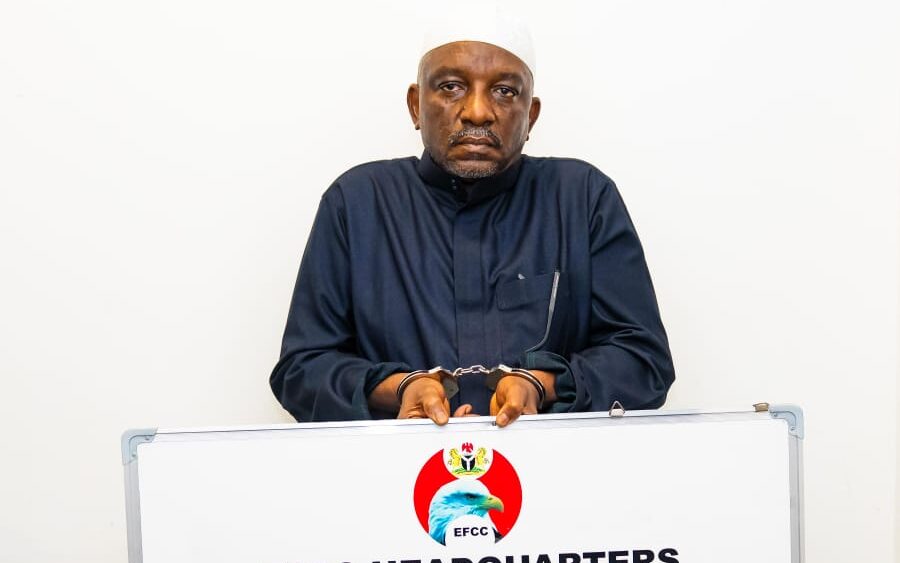
Court orders forfeiture of jailed ex-minister Saleh Mamman’s Abuja, Kaduna properties
Abstract
The Federal High Court in Abuja has ordered the permanent forfeiture of one property and the interim forfeiture of four others linked to former Minister of Power, Saleh Mamman. These orders follow Mamman's conviction on 12 counts of corruption and money laundering, involving N33.8 billion, for which he was sentenced to a cumulative 75 years in prison. The forfeited assets, located in Abuja and Kaduna, represent a significant step in Nigeria's ongoing efforts to recover proceeds of crime and reinforce the legal framework for asset recovery, particularly under the Economic and Financial Crimes Commission (Establishment) Act and the Proceeds of Crime (Recovery and Management) Act.
Introduction
In a significant development for Nigeria's anti-corruption campaign, the Federal High Court in Abuja has issued further forfeiture orders against properties linked to Saleh Mamman, the former Minister of Power. This action comes on the heels of Mr. Mamman's recent conviction and sentencing to a cumulative 75 years in prison for corruption and money laundering offenses involving N33.8 billion. The court's decision to permanently forfeit one property and grant interim forfeiture for four others underscores the judiciary's commitment to asset recovery as a critical component of combating financial crimes by public officials.
These latest orders are not isolated but form part of a broader strategy by the Economic and Financial Crimes Commission (EFCC) to trace, recover, and manage assets acquired through illicit means. The case of Saleh Mamman, who served under former President Muhammadu Buhari, highlights the robust application of Nigeria's anti-graft laws and signals a strengthened resolve to ensure that public office holders are held accountable for their actions. For legal practitioners, this case offers crucial insights into the evolving landscape of asset forfeiture proceedings and the increasing effectiveness of anti-corruption agencies.
Background
Nigeria's legal framework for combating corruption and money laundering is primarily anchored in several key statutes designed to facilitate the investigation, prosecution, and asset recovery processes. Central among these are the Economic and Financial Crimes Commission (Establishment) Act 2004 (EFCC Act), the Money Laundering (Prevention and Prohibition) Act 2022 (MLPPA), and the Proceeds of Crime (Recovery and Management) Act 2022 (POCA). The EFCC Act establishes the primary anti-graft agency, empowering it to investigate and prosecute economic and financial crimes, and crucially, to seize and confiscate assets suspected to be proceeds of crime.
The MLPPA 2022, which repealed its 2011 predecessor, strengthens provisions for tracing and recovering assets derived from money laundering activities, while POCA 2022 provides the most comprehensive legal framework for the seizure, confiscation, forfeiture, and management of properties reasonably suspected to have been derived from unlawful activities. POCA is particularly significant as it allows for both conviction-based and non-conviction-based forfeiture, emphasizing the recovery of illicit gains regardless of whether a criminal conviction has been secured. In Mr. Mamman's case, the forfeiture orders are conviction-based, directly linked to his established culpability in money laundering and corruption. These legislative instruments collectively provide the EFCC and the courts with extensive powers to divest criminals of their ill-gotten wealth, thereby deterring corruption and reinforcing public trust.
Analysis
The forfeiture orders against Saleh Mamman's properties stem directly from his conviction by Justice James Omotosho of the Federal High Court in Abuja on May 7, 2026. Mr. Mamman was found guilty on all 12 counts of an amended charge bordering on money laundering and conspiracy, specifically related to the diversion of N33.8 billion intended for the Zungeru and Mambilla hydroelectric power projects. The court established that at least N22 billion was siphoned through proxy companies and accomplices, with evidence showing a cash payment of $655,700 (equivalent to about N200 million) for a landed property in Abuja without recourse to a financial institution.
Following his conviction, Mr. Mamman was sentenced on May 13, 2026, to a cumulative 75 years in prison, with sentences to run consecutively upon his arrest, as he was tried and convicted in absentia. The recent forfeiture orders, delivered by Justice Omotosho on July 2, 2026, include the permanent forfeiture of Walijam Apartments, located at Plot 435, No. 43 Lobito Crescent, Wuse 2, Abuja. The court held that the EFCC successfully proved this property was acquired with proceeds of unlawful activities. Additionally, interim forfeiture orders were granted for four other properties: Bloom Luxury Suites Nigeria Limited in Unguwan Rimi, Kaduna State; two mansions at No. 11 and No. 13 Misratah Street, Wuse 2, Abuja; and A.U.A Plaza on Plot 734 Kade Street, Wuse 2, Abuja. The EFCC was directed to publish these interim orders in a national newspaper, allowing interested parties to show cause why they should not be permanently forfeited.
The legal basis for these forfeiture orders is firmly rooted in the EFCC Act 2004 and the Proceeds of Crime (Recovery and Management) Act 2022. Sections 20, 21, 24, 25, 26, 29, 30, and 31 of the EFCC Act empower the court to order the forfeiture of properties derived from criminal activities, both on an interim and final basis, particularly after a conviction. POCA 2022, especially Part IV, further solidifies these powers, providing for the recovery and forfeiture of proceeds of crime. Section 74 of POCA places the burden of proving legitimate ownership on the defendant for assets suspected to be proceeds of crime. Notably, the court rejected the argument that it was *functus officio* after sentencing, affirming its jurisdiction to hear the forfeiture application under Section 321 of the Administration of Criminal Justice Act (ACJA) 2015, which empowers courts to make restitution orders post-conviction. This ruling reinforces the judiciary's expansive powers in asset recovery, ensuring that the process continues until the full extent of illicit gains is recovered. The EFCC continues its efforts to recover the outstanding N22 billion traced to Mr. Mamman.
Conclusion
The forfeiture orders in the case of former Minister Saleh Mamman represent a significant victory for anti-corruption efforts in Nigeria, demonstrating the judiciary's resolve to ensure that public officials are held accountable and that illicitly acquired assets are returned to the state. These actions, driven by the diligent work of the EFCC and supported by robust legislation like the EFCC Act and POCA, send a clear message that corruption will not go unpunished, and its proceeds will be aggressively pursued.
For legal practitioners, this case highlights several critical implications. Firstly, it underscores the importance of thorough due diligence in property transactions, especially when dealing with politically exposed persons. Secondly, it emphasizes the need for public officials to maintain meticulous records and ensure transparent asset declarations, as the burden of proving legitimate acquisition can fall squarely on them. Finally, the court's affirmation of its powers to order forfeiture post-conviction, even when the *functus officio* argument is raised, signals a proactive judicial approach to asset recovery. Practitioners should advise clients, particularly those in public service, on the stringent requirements of anti-corruption laws and the far-reaching consequences of non-compliance, as the trend towards aggressive asset recovery is set to continue.
Citations
- 1.Economic and Financial Crimes Commission (Establishment) Act 2004
- 2.Money Laundering (Prevention and Prohibition) Act 2022
- 3.Proceeds of Crime (Recovery and Management) Act 2022
- 4.Administration of Criminal Justice Act 2015
- 5.Federal Republic of Nigeria v. Saleh Mamman, FHC/ABJ/CR/273/2024