
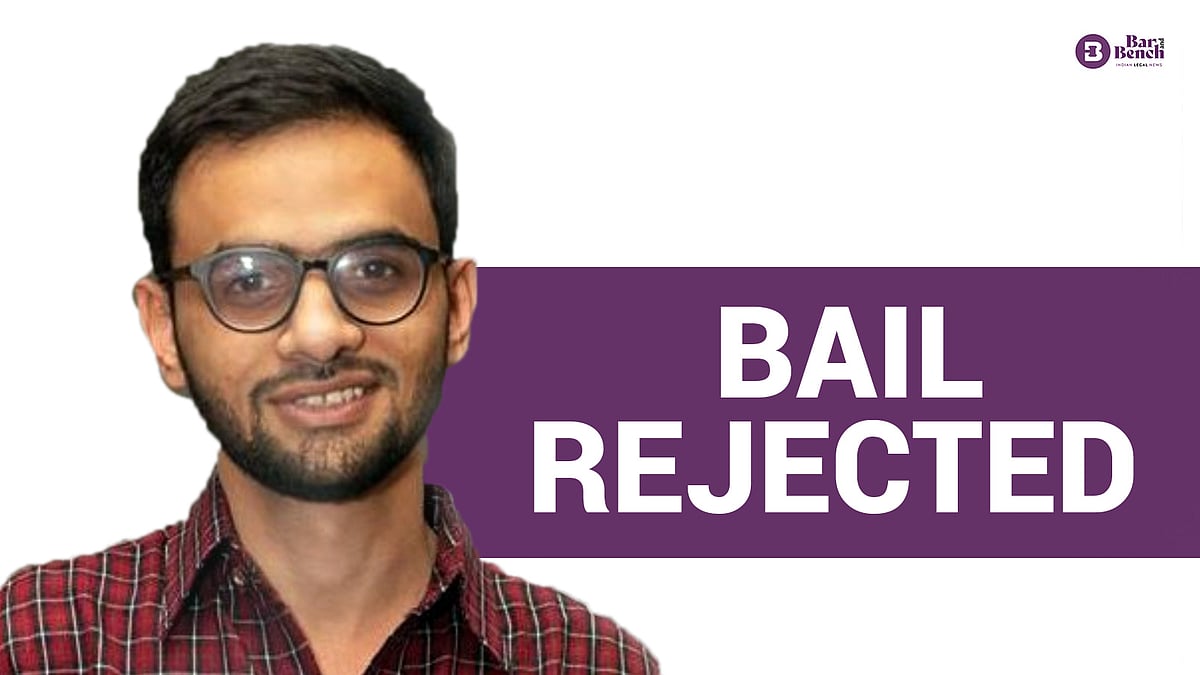
Delhi court denies bail to Umar Khalid, Sharjeel Imam in Delhi riots conspiracy case
Abstract
A Delhi court recently dismissed fresh bail applications filed by activists Umar Khalid and Sharjeel Imam in the Delhi riots conspiracy case (FIR 59/2020). Additional Sessions Judge Sameer Bajpai ruled that the trial court was bound by a Supreme Court order dated January 5, 2026, which had previously rejected their bail pleas. The Supreme Court's order had stipulated specific conditions for renewing bail, namely, the completion of the examination of protected witnesses or the expiry of one year from the date of the said order, whichever was earlier. Consequently, the Delhi court held that the current applications were not maintainable, reinforcing the principle of judicial hierarchy and the stringent bail regime under the Unlawful Activities (Prevention) Act, 1967 (UAPA).
Introduction
In a significant development for ongoing legal proceedings related to the 2020 Delhi riots, a Delhi court on Saturday, July 4, 2026, dismissed fresh bail applications filed by prominent activists Umar Khalid and Sharjeel Imam. The decision, rendered by Additional Sessions Judge Sameer Bajpai, underscores the strict adherence to judicial precedent and the formidable challenges faced by accused individuals in cases involving the Unlawful Activities (Prevention) Act, 1967 (UAPA). The court explicitly stated its inability to entertain the pleas, citing a binding Supreme Court order from January 5, 2026, which had laid down specific conditions for the renewal of their bail prayers.
This ruling has critical implications for bail jurisprudence, particularly in cases where higher courts impose conditional restrictions on subsequent bail applications. It highlights the interplay between the constitutional mandate of judicial discipline under Article 141 and the fundamental right to liberty, especially within the context of anti-terror legislation. The present article delves into the legal rationale behind the Delhi court's decision, examining the statutory framework governing bail in UAPA cases, the Supreme Court's earlier pronouncement, and the broader implications for legal practitioners navigating complex criminal proceedings.
The dismissal of these applications, nearly six months after the Supreme Court's conditional order, brings into sharp focus the protracted nature of trials under the UAPA and the limited avenues available for relief when specific judicial directives are in place. It necessitates a closer look at how courts balance the stringent provisions of special laws with the constitutional rights of the accused, particularly concerning prolonged incarceration without trial.
Background
The genesis of the present bail applications lies in the larger conspiracy case (FIR No. 59/2020) registered by the Delhi Police Special Cell, pertaining to the communal violence that erupted in North East Delhi in February 2020. Umar Khalid and Sharjeel Imam are among several individuals accused under various provisions of the Indian Penal Code, 1860, the Arms Act, and crucially, the Unlawful Activities (Prevention) Act, 1967 (UAPA). The UAPA, particularly Section 43D(5), imposes stringent conditions for the grant of bail, stipulating that bail shall not be granted if the court has reasonable grounds to believe that the accusation against such person is 'prima facie true' based on the case diary or the investigation report.
Both Khalid and Imam have been in judicial custody for several years, with their previous bail applications being consistently rejected by the trial court and the Delhi High Court. Their journey for bail culminated in the Supreme Court of India, which, on January 5, 2026, heard their pleas along with those of other co-accused. While the Supreme Court granted conditional bail to five co-accused—Gulfisha Fatima, Meeran Haider, Shifa Ur Rehman, Mohammad Saleem Khan, and Shadab Ahmad—it denied bail to Umar Khalid and Sharjeel Imam.
The apex court, in its January 2026 order, distinguished the roles of Khalid and Imam, observing a 'hierarchy of participation' and a 'larger conspiracy' attributed to them, setting them on a 'qualitatively different footing' compared to the others. Crucially, the Supreme Court, while dismissing their pleas, expressly granted liberty to Khalid and Imam to renew their prayer for bail before the jurisdictional court only upon the completion of the examination of protected witnesses relied upon by the prosecution, or upon the expiry of a period of one year from the date of the said order, whichever was earlier. This specific directive formed the bedrock of the Delhi court's recent decision.
Analysis
The Delhi court's dismissal of the fresh bail applications was rooted firmly in the doctrine of *stare decisis* and the principle of judicial discipline, as enshrined in Article 141 of the Constitution of India. Article 141 mandates that the law declared by the Supreme Court is binding on all courts within the territory of India. Additional Sessions Judge Sameer Bajpai unequivocally stated that the trial court had "no option but to follow the judgment dated 05.01.2026, as passed by the Hon'ble Supreme Court, whereby the petitions of both the applicants were dismissed."
The Supreme Court's January 2026 order was not an outright denial but a conditional one, setting precise prerequisites for the renewal of bail applications. The conditions—completion of protected witness examination or the lapse of one year from the order date—were explicit. The trial court correctly interpreted this as a jurisdictional bar, precluding it from entertaining fresh applications until either of these conditions was met. This highlights the binding nature of specific directives from the apex court, even when lower courts might otherwise consider arguments pertaining to changed circumstances or prolonged incarceration.
Defence counsel for Khalid and Imam had argued that there had been a significant change in circumstances, including prolonged incarceration (nearly six years) without substantial progress in the trial, and relied on the Supreme Court's subsequent ruling in *Syed Iftikhar Andrabi v. NIA*, which reportedly reaffirmed the principle that prolonged incarceration could justify bail. However, the prosecution countered that the Supreme Court had already rejected their bail pleas, and Khalid's review petition had also been dismissed. The trial court declined to delve into the 'changed circumstances' argument, noting that the apparent divergence between the Supreme Court's decisions in *Gulfisha Fatima v. State (Govt. of NCT of Delhi)* and *Syed Iftikhar Andrabi v. NIA* had already been referred to a larger bench of the Supreme Court for resolution.
This decision underscores the inherent difficulties in securing bail under Section 43D(5) of the UAPA, which places a heavy burden on the accused by shifting the presumption against bail if a 'prima facie true' case is established by the prosecution. While the Supreme Court, in an unrelated case in May 2026, observed that Section 43D(5) cannot justify indefinite incarceration and that "bail is the rule and jail is the exception" even under stringent anti-terror laws, this broader jurisprudential development could not override the specific, binding conditions imposed by the Supreme Court in Khalid and Imam's own case. The trial court's hands were tied by the direct mandate of the superior court, illustrating the strict vertical application of precedent in the Indian judicial system.
Conclusion
The Delhi court's dismissal of Umar Khalid and Sharjeel Imam's fresh bail applications serves as a clear affirmation of the principle of judicial hierarchy and the binding nature of Supreme Court directives. For legal practitioners, this case highlights the critical importance of understanding the precise contours of orders issued by higher courts, particularly when they impose conditions on future applications for relief. Even compelling arguments regarding prolonged incarceration or evolving bail jurisprudence may be rendered non-maintainable if they directly contravene specific instructions from the apex court.
Looking ahead, the immediate fate of Khalid and Imam remains tied to the fulfillment of the Supreme Court's conditions: either the completion of protected witness examinations or the expiry of one year from January 5, 2026. Practitioners involved in UAPA cases must closely monitor the progress of trials and the calendar for such conditional liberties. Furthermore, the ongoing reference to a larger bench of the Supreme Court concerning the interpretation of Section 43D(5) of the UAPA and the balance between national security and the right to personal liberty will be a crucial development to watch, as it may shape the future landscape of bail jurisprudence in anti-terror cases across India.
Citations
- 1.Constitution of India, 1950, Article 141
- 2.Unlawful Activities (Prevention) Act, 1967, Section 43D(5)
- 3.FIR No. 59/2020, Delhi Police Special Cell