
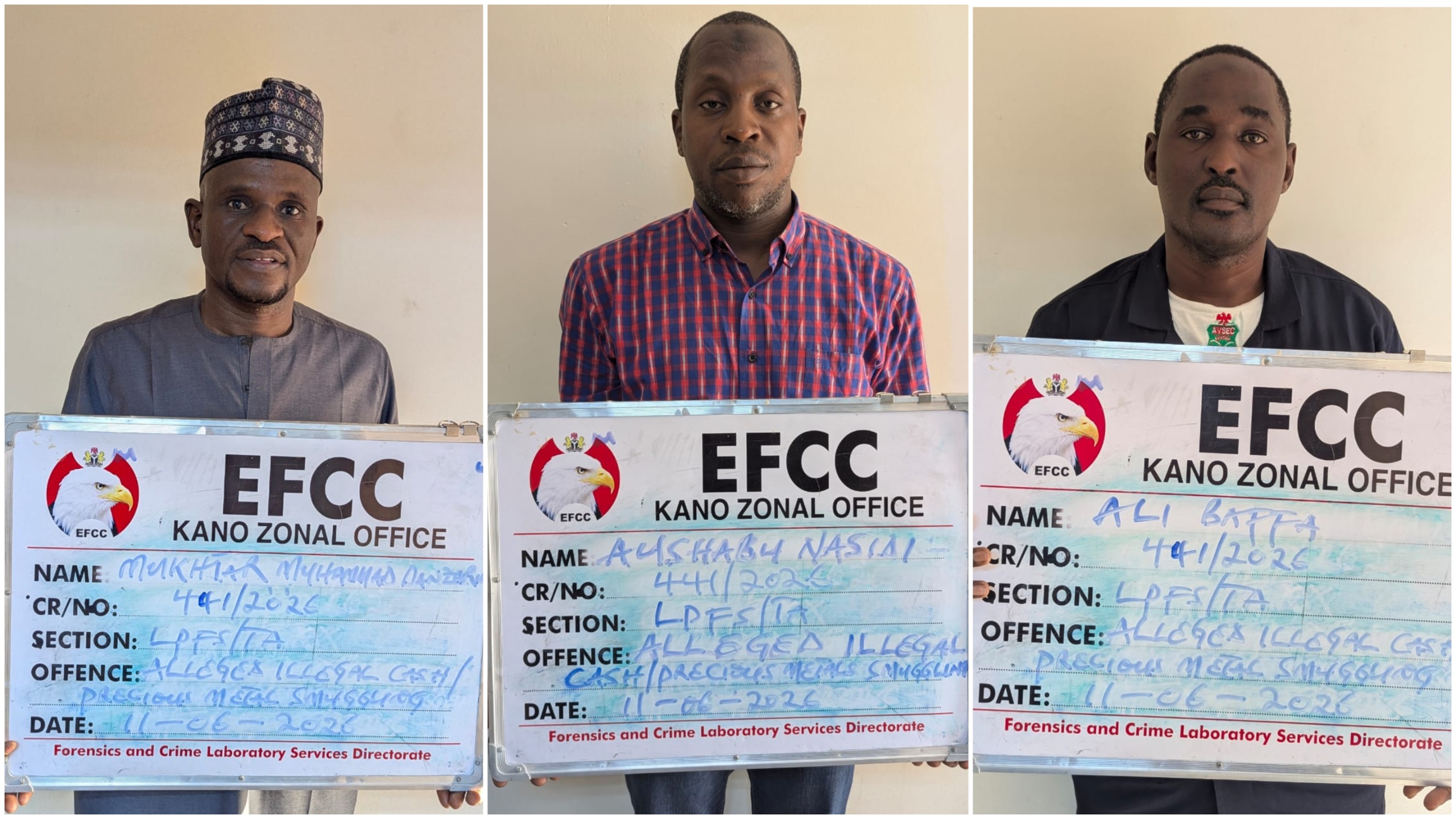
EFCC arrests aviation security officer, two others over alleged attempt to smuggle gold worth N4.4bn
Abstract
The Economic and Financial Crimes Commission (EFCC) recently apprehended an Aviation Security (AVSEC) officer and two accomplices at the Mallam Aminu Kano International Airport for allegedly attempting to smuggle 22.2 kilograms of unprocessed gold bars, valued at over N4.4 billion. This incident highlights Nigeria's ongoing struggle against illicit financial flows and the illegal exploitation of its mineral resources. The arrests underscore the EFCC's intensified efforts, under its enabling Act and the Money Laundering (Prevention and Prohibition) Act 2022, to combat such economic sabotage. Legal practitioners should note the potential charges under customs laws and anti-money laundering legislation, as well as the robust asset forfeiture provisions available to the state in such cases.
Introduction
Nigeria's fight against economic and financial crimes has once again been brought to the forefront with the recent arrest by the Economic and Financial Crimes Commission (EFCC) of an Aviation Security (AVSEC) officer and two others at the Mallam Aminu Kano International Airport. The suspects were allegedly involved in an attempt to smuggle 22.2 kilograms of unprocessed gold bars, estimated to be worth over N4.4 billion. This high-value seizure, which also involved the recovery of various foreign currencies, signals a significant development in the nation's efforts to curb illicit financial flows and the illegal export of its natural resources.
This incident is particularly alarming given the alleged involvement of an aviation security officer, a position of trust, in facilitating such a large-scale economic crime. It underscores the pervasive nature of corruption and the sophisticated networks employed by economic saboteurs. For legal professionals, this case presents a critical examination of the interplay between anti-money laundering legislation, customs laws, and the powers of anti-graft agencies in Nigeria. This article will delve into the legal framework governing such offences, the potential charges, and the broader implications for enforcement and compliance.
Background
The legal landscape for combating economic and financial crimes in Nigeria is primarily anchored by the Economic and Financial Crimes Commission (Establishment) Act, 2004 (EFCC Act) and the Money Laundering (Prevention and Prohibition) Act, 2022 (MLPPA 2022). The EFCC Act establishes the Economic and Financial Crimes Commission as the principal agency responsible for the investigation, enforcement, and prosecution of economic and financial crimes, including money laundering, advance fee fraud, and corruption-related offences. The Commission is vested with extensive investigative powers, including the authority to trace, freeze, confiscate, or seize proceeds derived from economic and financial crimes.
The Money Laundering (Prevention and Prohibition) Act, 2022, which repealed the Money Laundering (Prohibition) Act, 2011, provides a comprehensive legal and institutional framework for the prevention, prohibition, detection, prosecution, and punishment of money laundering and related offences. Key provisions of the MLPPA 2022 include the prohibition of cash payments exceeding N5,000,000 for individuals and N10,000,000 for corporate bodies, except in transactions through a financial institution. Crucially, it mandates the declaration of cash or negotiable instruments exceeding $10,000 to the Nigeria Customs Service when transferred to or from a foreign country. The Act also established the Special Control Unit Against Money Laundering (SCUML) under the EFCC to supervise compliance.
Complementing these anti-graft laws are the provisions of the Customs and Excise Management Act (CEMA), which governs importation, exportation, and customs duties. The CEMA Amendment Bill, 2022, assented to by the President, introduced stiffer penalties for smuggling and duty evasion, reflecting the government's commitment to deterring economic crimes. While the Nigeria Customs Service Act, 2023, has since repealed CEMA, the principles and offences related to smuggling remain largely consistent, with a focus on preventing the illegal movement of goods across borders and ensuring proper declaration and payment of duties.
Analysis
The arrest of the aviation security officer and his alleged accomplices for attempting to smuggle N4.4 billion worth of gold implicates several key pieces of Nigerian legislation. The primary charges are likely to revolve around smuggling, money laundering, and conspiracy. Under the Customs and Excise Management Act (CEMA), offences related to improper importation or exportation of goods carry significant penalties. For instance, Section 47 of CEMA provides for imprisonment for a term of five years without an option of fine for improper importation, while Section 64 addresses improper exportation with a similar penalty. The concealment and wrong entry of goods by importers or their agents can attract a jail term of three years or a fine of six times the true value of revenue lost, alongside the forfeiture of the smuggled items.
Beyond smuggling, the act of moving such a large quantity of undeclared gold, particularly when concealed, strongly suggests an attempt to launder proceeds of crime. The Money Laundering (Prevention and Prohibition) Act, 2022, would be highly relevant here. Section 18(2) of the MLPPA 2022 stipulates acts or omissions by which any person or corporate body may be guilty of money laundering. The non-declaration of cash or negotiable instruments exceeding $10,000 to the Nigeria Customs Service, as required by Section 8 of the MLPPA 2022, would constitute a clear breach. Given the N4.4 billion value of the gold, the transaction far exceeds the N5 million cash payment limit for individuals, further strengthening the money laundering allegations.
The EFCC's mandate under the EFCC Act, 2004, empowers it to investigate and prosecute all financial crimes, including money laundering. The Commission's proactive surveillance operation at the airport, following a directive to intensify efforts against illegal movement of mineral resources and bulk cash, demonstrates its commitment to enforcing these laws. The fact that one of the suspects allegedly admitted to previously smuggling about 40.2 kilograms of gold using the same method could be crucial evidence, indicating a pattern of criminal activity and potentially a larger network.
Furthermore, the EFCC possesses robust powers for asset forfeiture, both interim and final, for properties derived from unlawful activities. Sections 27, 28, 29, 30, and 31 of the EFCC Act, 2004, outline the procedures for interim and final forfeiture orders. Recent cases, such as the final forfeiture order secured by the EFCC for N3.44 billion and properties linked to a former Managing Director of NGPIC, and the ongoing efforts to forfeit properties linked to a former Attorney General, illustrate the courts' willingness to grant such orders where proceeds of crime are established. This means that not only the seized gold but also any other assets traceable to the illicit activities of the suspects could be subject to forfeiture to the Federal Government.
This case also highlights the broader issue of illicit financial flows and the smuggling of solid minerals, which the EFCC has previously identified as a significant challenge, particularly concerning raw gold from Zamfara state. The involvement of an aviation security officer underscores the need for enhanced vigilance and integrity checks within critical national infrastructure to prevent complicity in economic sabotage. The prosecution will likely focus on establishing the intent to evade customs duties and the illicit origin or intended use of the gold, leveraging the comprehensive provisions of both the customs and anti-money laundering statutes.
Conclusion
The arrest of an aviation security officer and two others for the attempted smuggling of N4.4 billion worth of gold represents a significant enforcement action by the EFCC, reinforcing Nigeria's commitment to combating economic crimes and protecting its national assets. This case serves as a potent reminder of the severe legal consequences for individuals and syndicates involved in smuggling and money laundering, particularly under the robust frameworks of the EFCC Act, 2004, and the Money Laundering (Prevention and Prohibition) Act, 2022, as well as the relevant customs legislation.
For legal practitioners, this incident underscores the critical importance of advising clients, especially those in sectors susceptible to illicit financial flows, on strict compliance with anti-money laundering regulations, customs declarations, and ethical conduct. Defence counsel will need to navigate complex evidentiary requirements, challenging the prosecution's ability to prove intent and the illicit nature of the funds or goods. As investigations continue and the suspects face arraignment, the legal community will be closely watching the prosecution's strategy and the courts' interpretation and application of these vital economic crime statutes, particularly concerning asset forfeiture and the deterrence of official complicity in such offences.
Citations
- 1.Economic and Financial Crimes Commission (Establishment) Act, 2004
- 2.Money Laundering (Prevention and Prohibition) Act, 2022
- 3.Customs and Excise Management Act (CEMA)
- 4.Nigeria Customs Service Act, 2023
- 5.Premium Times Nigeria, "EFCC arrests aviation security officer, two others over alleged attempt to smuggle gold worth N4.4bn"
- 6.TheNigeriaLawyer, "“22.2kg Gold Hidden In Trousers” — EFCC Arrests AVSEC Officer, Two Others Over Alleged ₦4.4bn Gold, Foreign Currency Smuggling At Kano Airport"
- 7.BusinessDay, "EFCC busts alleged N4.4bn gold smuggling ring at Kano Airport, arrests AVSEC officer"
- 8.Morgan Cole Partners, "A REVIEW OF THE MONEY LAUNDERING ACT 2022"
- 9.PwC, "An overview of the Key Provisions of the Money Laundering (Prevention and Prohibition) Act 2022"
- 10.Aluko & Oyebode, "Money Laundering (Prevention & Prohibition) Act 2022"
- 11.TEMPLARS Law, "The Money Laundering Bill 2022"
- 12.AO2LAW, "APPLICATION OF THE MONEY LAUNDERING (PROHIBITION) ACT TO LEGAL PRACTITIONERS IN NIGERIA: THE JOURNEY SO FAR"
- 13.BJ Attorneys, "Economic and Financial Crimes Commission (Establishment) Act, 2004"
- 14.PolicyVault.Africa, "Economic and Financial Crimes Commission Act, 2004"
- 15.Wikipedia, "Economic and Financial Crimes Commission"
- 16.International Journal of Law, "The economic and financial crimes commission and its role in curbing corruption in Nigeria: Evaluating the success story so far"
- 17.Lawhaven solicitors, "POWER OF EFCC IN NIGERIA"
- 18.FCT EMIS, "ECONOMIC AND FINANCIAL CRIME COMMISSION EFCC is a Nigeria law enforcement agency that investigates financial crimes like advance"
- 19.NACIWA, "Court Orders Final Forfeiture of N3.44bn and Properties in EFCC Nigeria Anti-Corruption Case"
- 20.The Guardian Nigeria News, "EFCC secures court order to freeze ex-AGoF's assets"
- 21.Channels TV, "Fraud: Court Orders Final Forfeiture Of Convicted Ex-AGoF's Multi-Billion Naira Assets, Investments"
- 22.Punch Newspapers, "EFCC moves to seize 57 Malami-linked properties"
- 23.RSIS International, "The Role of the Nigeria Customs Service (NCS) in the Prosecution of Smuggling Offences in Nigeria"
- 24.THE GUARDIAN - abokiFX News | Forex Updates, "Smugglers, others face stiffer penalties as Customs amends Act"
- 25.Vanguard News, "Money laundering: Unscrupulous elements smuggling raw gold from Nigeria - EFCC"
How does this affect your business?
Get an AI analysis of this article grounded in your jurisdictions, practice areas, and any policy documents you've uploaded to Wansom.