
Fresh PIL in Kerala HC challenges Waqf Board composition, former MLA's continued membership
Abstract
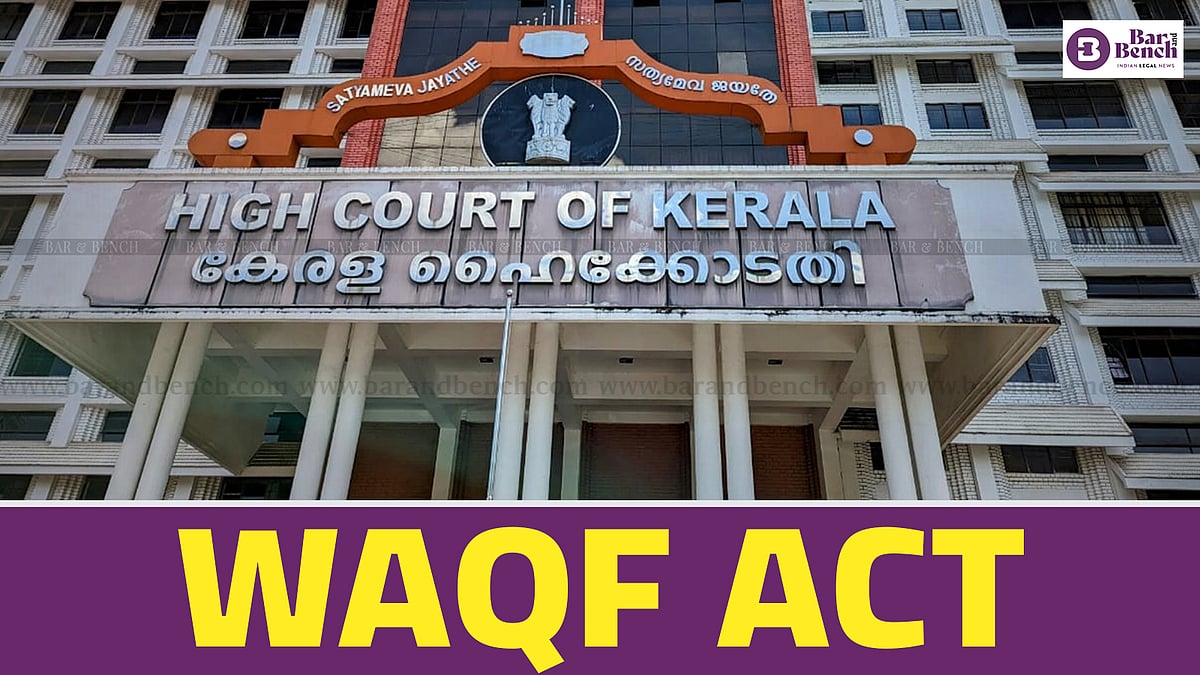
A fresh Public Interest Litigation (PIL) has been filed before the Kerala High Court, challenging the composition of the Kerala State Waqf Board. The petition, titled *Stalin VM alias Stalin Devan v State of Kerala & ors*, specifically questions the continued membership of former CPI(M) MLA Kunhammed Kutty Master on the Board, despite his having lost his status as a Member of the Legislative Assembly (MLA) following the 2026 Kerala Assembly elections. This, the petitioner contends, is a direct violation of the statutory scheme outlined in the amended Waqf Act, 1995. This latest challenge adds to two other pending petitions before the Court, which primarily question the absence of mandatory non-Muslim members and the Board's actions concerning the disputed Munambam land, highlighting broader concerns about the Board's legal constitution and operational integrity.
Introduction
The Kerala High Court is currently seized of a significant Public Interest Litigation (*Stalin VM alias Stalin Devan v State of Kerala & ors*) that casts a shadow over the legitimacy and composition of the Kerala State Waqf Board. Filed by retired Indian Army Junior Warrant Officer and former Kerala government under secretary, Stalin VM, the petition specifically targets the continued tenure of former CPI(M) MLA Kunhammed Kutty Master on the Board. The core contention is that Mr. Kutty Master's membership, which was initially secured under a category reserved for sitting Members of the Legislative Assembly, became untenable upon his loss of MLA status in the 2026 Kerala Assembly elections, thereby contravening the express provisions of the Waqf Act, 1995.
This legal challenge is not an isolated incident but forms part of a growing chorus of petitions questioning the Board's adherence to statutory mandates. Two other PILs are already pending before the High Court, one filed by Bharatiya Janata Party (BJP) State Vice President Shone George, and another by a Christian trust, both raising concerns about the absence of mandatory non-Muslim members and the Board's controversial actions regarding the Munambam land dispute. The cumulative effect of these petitions underscores a critical need for strict compliance with the legal framework governing the constitution of statutory bodies, particularly those entrusted with the administration of significant public endowments.
This article will delve into the legal arguments presented in the latest PIL, focusing on the interpretation and application of Section 14 of the Waqf Act, 1995. It will analyze how the alleged statutory violation impacts the Board's legal standing and examine the broader implications for the administration of Waqf properties in Kerala, especially in light of the interconnected challenges concerning representation and land disputes.
Background
The administration and management of Waqf properties in India are governed by the Waqf Act, 1995 (Central Act 43 of 1995), which establishes State Waqf Boards to oversee these permanent endowments made by Muslims for religious, pious, or charitable purposes. Section 14 of the Act is pivotal, outlining the specific composition requirements for these Boards. It mandates a diverse membership, including a Chairperson and elected members from various electoral colleges, such as Muslim Members of Parliament, Muslim Members of the State Legislature, Muslim members of the Bar Council, and Mutawallis of Waqfs with a specified annual income.
Crucially, Section 14(1)(b)(ii) specifically provides for the election of Muslim Members of the State Legislature to the Board. To address situations where a member's qualifying status changes, Explanation II to Section 14(1) explicitly states: "For the removal of doubts it is hereby declared that in case a Muslim member ceases to be a Member of the State Legislative Assembly as required under sub-clause (ii) of clause (b), such member shall be deemed to have vacated the office of the member of the Board for the State or National Capital Territory of Delhi, as the case may be, from the date from which such member ceased to be a Member of the State Legislative Assembly, as the case may be." This provision unequivocally links the continuation of membership to the retention of the qualifying legislative status.
Further amendments to the Waqf Act in 2025 (often referred to as the UMEED Act) introduced a significant change, mandating the inclusion of at least two non-Muslim members in State Waqf Boards, excluding ex-officio members, to ensure secular oversight and professional diversity. The Supreme Court, in an interim order dated September 15, 2025, subsequently capped the number of non-Muslim members in State Waqf Boards at a maximum of three. It is against this detailed statutory backdrop that the current challenges to the Kerala State Waqf Board's composition, including the membership of former CPI(M) MLA Kunhammed Kutty Master, are being adjudicated. Mr. Kutty Master represented Kuttiady, Kerala, as an MLA from 2021 to 2026.
Analysis
The latest Public Interest Litigation by Stalin VM directly leverages the unequivocal language of Explanation II to Section 14(1) of the Waqf Act, 1995. This provision leaves no room for ambiguity: a member elected or nominated to the Waqf Board under the category of a Member of the State Legislature automatically vacates their office the moment they cease to be an MLA. Given that Kunhammed Kutty Master lost his MLA status following the 2026 Kerala Assembly elections, his continued presence on the Kerala State Waqf Board is, prima facie, in direct contravention of this mandatory statutory requirement. The petitioner's argument that Mr. Kutty Master's nomination barely two months before the expiry of his MLA tenure, with no certainty of re-election, was problematic, gains significant weight in light of this explicit cessation clause.
This specific challenge is intertwined with broader allegations of statutory non-compliance in the Board's constitution. The PIL filed by BJP State Vice President Shone George, for instance, highlights the Kerala government's failure to appoint the mandatory two non-Muslim members to the Board, as stipulated by the 2025 Waqf Amendment Act. The government's notification of February 4, 2026, which appointed nine members, all of whom are Muslim, with a mere promise of future appointments, is argued to be a deliberate flouting of the law. This directly contradicts the spirit of the amendment aimed at broader representation and the Supreme Court's interim directive capping non-Muslim members at three. Madhya Pradesh, in contrast, has already reconstituted its Waqf Board under the amended Act, including two Hindu members, setting a precedent for compliance.
Furthermore, the petition by the Assembly of Christian Trust Services (ACTS) raises similar concerns regarding the absence of non-Muslim members, as well as a lack of representation from specific Muslim communities like Shia, Bohra, and Aghakhani, and alleged irregularities in the selection of Mutawalli and Islamic scholar members. Both the ACTS petition and Stalin VM's PIL also bring into focus the Kerala State Waqf Board's contentious actions concerning the Munambam land dispute. The Kerala High Court has previously criticized the Board's claim over 404 acres of land in Munambam, ruling it a private donation and not Waqf property, and even terming the Board's actions as a “land-grabbing tactic.” The Board's subsequent decision to upload details of this heavily disputed land to the Union government's UMEED portal has further exacerbated the controversy, underscoring the critical need for a legally constituted and accountable Board.
The cumulative effect of these alleged statutory violations is significant. The petitioner in *Stalin VM alias Stalin Devan* contends that a Board constituted in "patent violation of the mandatory requirements governing its composition" inherently lacks jurisdiction. Consequently, all administrative, supervisory, and quasi-judicial decisions, proceedings, and orders issued by such a Board would be rendered "vulnerable to challenge for want of jurisdiction and is liable to be declared void and unenforceable in law." This argument, if accepted by the High Court, could have far-reaching implications, potentially invalidating numerous decisions made by the current Kerala State Waqf Board and necessitating its complete reconstitution.
Conclusion
The ongoing Public Interest Litigations before the Kerala High Court, particularly *Stalin VM alias Stalin Devan v State of Kerala & ors*, serve as a stark reminder to legal practitioners and governmental bodies alike about the imperative of strict adherence to statutory provisions governing the constitution of statutory authorities. The explicit language of Explanation II to Section 14(1) of the Waqf Act, 1995, regarding the automatic cessation of membership upon loss of a qualifying legislative status, highlights the non-negotiable nature of such mandates. Any deviation from these clear legal requirements not only undermines the rule of law but also exposes the entire functioning of the body to severe legal vulnerabilities.
The outcome of these interconnected petitions will be closely watched, as they hold the potential to significantly reshape the Kerala State Waqf Board. The High Court's interpretation of Section 14, especially concerning the cessation of membership and the enforcement of the 2025 amendments mandating non-Muslim representation, will establish crucial precedents. A ruling in favor of the petitioners could lead to the reconstitution of the Board, annulment of its past decisions, and a re-evaluation of its actions, particularly concerning contentious matters like the Munambam land dispute. Legal professionals advising state governments, statutory bodies, or religious trusts must meticulously review and ensure absolute compliance with all governing statutes and rules to preempt similar challenges and safeguard the integrity and legitimacy of such institutions.