
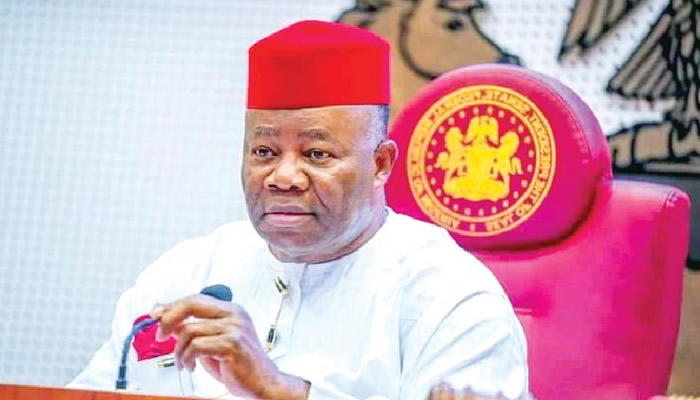
June 12: How to deepen Nigeria’s democracy —Akpabio, Falana, others
Abstract
Prominent Nigerian legal and political figures, including Senate President Godswill Akpabio, human rights activist Femi Falana, SAN, and National Human Rights Commission Executive Secretary Tony Ojukwu, SAN, recently convened to discuss strategies for deepening Nigeria's democracy. The discourse, held in commemoration of June 12, underscored critical areas such as electoral integrity, judicial independence, human rights protection, and active citizen participation. While acknowledging legislative advancements like the Electoral Act 2022, speakers highlighted persistent challenges including insecurity, poverty, and the gap between constitutional ideals and practical governance. The consensus pointed towards the necessity of robust institutions, accountability, and a judiciary free from undue influence to foster a truly democratic and just society in Nigeria.
Introduction
Nigeria's democratic journey, marked by the symbolic significance of June 12, continues to be a subject of critical evaluation and calls for reform. Recent discussions involving key legal and political stakeholders, including Senate President Godswill Akpabio, renowned human rights activist Mr. Femi Falana, SAN, the Executive Secretary of the National Human Rights Commission (NHRC), Mr. Tony Ojukwu, SAN, and retired Supreme Court Justice Abdu Aboki, have brought to the fore various perspectives on how to strengthen the nation's democratic foundations. These deliberations, held against a backdrop of ongoing challenges, emphasize that true democracy extends beyond periodic elections to encompass accountability, justice, and the welfare of the citizenry.
The dialogue reflects a collective aspiration to address systemic issues that impede the full realization of democratic dividends. From electoral integrity to the rule of law and human rights, the insights offered by these prominent figures provide a roadmap for legal professionals to understand the current landscape and potential avenues for advocacy and reform. This article will delve into the legal and institutional frameworks underpinning Nigeria's democracy, analyze the challenges identified by the speakers, and explore the proposed solutions, offering a comprehensive overview for practitioners navigating the complexities of the Nigerian legal system.
Background
The bedrock of Nigeria's democratic governance is the Constitution of the Federal Republic of Nigeria 1999 (as amended). Section 14(1) unequivocally declares Nigeria as a state based on the principles of democracy and social justice, further asserting that sovereignty belongs to the people and that the security and welfare of the people shall be the primary purpose of government. Chapter II of the Constitution outlines the Fundamental Objectives and Directive Principles of State Policy, which, though largely non-justiciable, set out the ideals for political, economic, social, educational, foreign policy, and environmental objectives. These provisions serve as the aspirational framework for democratic governance and human rights protection.
Key institutions are established to uphold these democratic principles. The Independent National Electoral Commission (INEC) is mandated to organize elections, with its powers significantly enhanced by the Electoral Act 2022. This Act introduced critical reforms, including the legalization of technology in elections, electronic transmission of results, and revised timelines for electoral processes. Complementing this, the National Human Rights Commission (NHRC), established by the National Human Rights Commission (Amendment) Act 1995 (as amended in 2010), serves as an extra-judicial mechanism to promote, protect, and enforce human rights in line with constitutional provisions and international treaties. The judiciary, as the third arm of government, plays a crucial role in interpreting laws, resolving disputes, and upholding the rule of law, with specific tribunals established under Section 285 of the 1999 Constitution to handle election petitions.
Analysis
The discussions highlighted a critical intersection of legal frameworks and practical implementation. Senate President Akpabio emphasized that the future of credible elections hinges not only on technology and legal reforms but also on character, leadership, and institutional trust, asserting that nations thrive when citizens believe in the fairness of their institutions. This aligns with the spirit of the Electoral Act 2022, which sought to improve electoral integrity through provisions like the electronic transmission of results and clearer guidelines for party primaries. However, the Supreme Court's stance on the electronic transmission of results, clarifying that the Electoral Act 2022 does not explicitly mandate it as a collation system, exposed a gap between legislative intent and judicial interpretation, leading to public debate on the need for statutory clarity.
Mr. Femi Falana, SAN, offered a more critical assessment, contending that Nigeria currently operates a 'civil rule' rather than a 'genuine democratic governance,' primarily due to the unfulfilled promises embedded in the Constitution and the pervasive issues of insecurity, poverty, and attacks on free speech. He argued that democracy's true test lies in its capacity to guarantee justice, accountability, human rights, and social welfare, rather than merely conducting periodic elections. This perspective underscores the non-justiciability of Chapter II of the Constitution, which, as Falana has noted in other contexts, contributes to a lack of accountability regarding socio-economic rights.
Justice Abdu Aboki (Rtd.), speaking on the judiciary, stressed the paramount importance of judicial independence, asserting that it is the bedrock of impartial justice and must be free from undue influence from other arms of government. This sentiment resonates deeply within a system where the judiciary is often called upon to resolve complex political disputes, including electoral petitions. The NHRC, through its Executive Secretary Mr. Tony Ojukwu, SAN, reinforced the idea that democracy thrives on active citizen participation, respect for civic freedoms, and transparent electoral processes, recognizing electoral integrity as a fundamental human rights concern. The Commission's mandate to monitor human rights, investigate violations, and assist victims is crucial in ensuring that democratic practices are not undermined by abuses.
However, despite these legal and institutional safeguards, challenges persist. The issue of conflicting court judgments, particularly in electoral matters, has been identified as eroding public trust in the judiciary. Furthermore, the practical implications of insecurity on voter participation and the overall credibility of elections, as highlighted by Falana, remain a significant concern. The call for increased accountability and a commitment to transforming constitutional ideals into practical realities through effective leadership and institutional reforms forms a recurring theme among the various stakeholders.
Conclusion
The collective insights from Senate President Akpabio, Mr. Femi Falana, SAN, Mr. Tony Ojukwu, SAN, and Justice Abdu Aboki (Rtd.) provide a multi-faceted view of the ongoing efforts and inherent challenges in deepening Nigeria's democracy. For legal practitioners, these discussions underscore the critical need for vigilance and engagement with electoral laws, constitutional provisions, and human rights instruments. The emphasis on institutional integrity, particularly within INEC and the judiciary, suggests that future litigation and advocacy efforts will likely focus on ensuring strict adherence to the Electoral Act 2022 and upholding judicial independence.
Practitioners should closely monitor legislative efforts to clarify ambiguities in electoral laws, especially concerning technology and result transmission, to prevent future judicial interpretations that may diverge from public expectations. Furthermore, the call for greater accountability and the protection of civic freedoms by the NHRC and civil society leaders signals a growing imperative for lawyers to champion human rights cases and advocate for the justiciability of socio-economic rights. The path to a more robust Nigerian democracy demands not only legal expertise but also a commitment to ethical practice and active participation in shaping a governance structure that truly serves the security and welfare of its people.
Citations
- 1.Constitution of the Federal Republic of Nigeria 1999 (as amended)
- 2.Electoral Act 2022
- 3.National Human Rights Commission (Amendment) Act 1995 (as amended 2010)
- 4.Vanguard News, “June 12: How to deepen Nigeria’s democracy —Akpabio, Falana, others” (June 9, 2026)
- 5.Leadership Newspapers, “Democracy Sustained By Faith, Prayer, Unity – Akpabio” (June 8, 2026)
- 6.Premium Times, “Democracy Day: Leaders, CSOs Warn of Democratic Backslide, Demand Reforms” (June 13, 2026)
- 7.Premium Times, “Democracy Day: Akpabio calls for unity, resilience, citizen participation” (June 12, 2026)
- 8.Voice of Nigeria, “Democracy Thrives on Citizens' Participation - NHRC” (June 3, 2026)
- 9.Realnews Magazine, “Democracy thrives where citizens' rights to participation in governance are respected- NHRC ES” (June 1, 2026)
- 10.THISDAYLIVE, “Falana: Nigeria Operating Civil Rule, Not Genuine Democratic Governance” (June 14, 2026)
- 11.Apex News Exclusive, “Nigeria has civil rule, not democracy- Falana” (June 14, 2026)
- 12.allAfrica.com, “Nigeria: Judiciary Must Be Free From Undue Influence - Kano CJ” (June 3, 2024)
- 13.TheNigeriaLawyer, “Justice Abdu Aboki Through The Cases” (February 2, 2023)
- 14.LEADERSHIP Newspapers, “Abdu Aboki Bows Out of Judiciary After Over 40 Years Meritorious Service” (September 20, 2022)
- 15.International IDEA, “Addressing Nigeria's Unresolved Electoral Reform Issues” (August 29, 2024)
- 16.Policy and Legal Advocacy Centre, “Key Provisions in the Electoral Act 2022” (March 2022)
- 17.Policy and Legal Advocacy Centre, “Electoral Act 2022”
- 18.Global Law Experts, “Some Distinctive Features Of Nigeria's Electoral Act 2022”
- 19.ActionAid Nigeria, “The Electoral Act 2022”
- 20.Wikipedia, “National Human Rights Commission (Nigeria)”
- 21.CFNHRI, “Nigeria” (National Human Rights Commission)
- 22.OHCHR, “National Human Rights Commission of Nigeria”
- 23.Journal of Political Discourse, “repositioning the national human rights commission for advancing the promotion, protection and enforcement of”
- 24.Federal Republic of Nigeria Official Gazette, “National Human Rights Commission Act, 1995”
- 25.NHRC, “Chief (Dr.) Anthony Okechukwu Ojukwu, OFR, SAN, FICMC.”
- 26.Wikipedia, “Anthony Ojukwu”
- 27.Constitute Project, “Nigeria 1999”
- 28.ICNL, “Chapter II” (Constitution of the Federal Republic of Nigeria)
- 29.FOIA, “THE 1999 CONSTTUTITON AND FREEDOM OF INFORMATION: RELEVANT PROVISIONS SECTION 4. – LEGISLATIVE POWERS”
- 30.UNISA Press Journals, “Courts' Involvement in the Electoral Process and Their Impact on Improving Election Quality in Nigeria”
- 31.Policy and Legal Advocacy Centre, “Supreme Court Judgment Declines Jurisdiction on Electoral Act Amendment” (July 1, 2022)
- 32.Centre for Democracy and Development, “reviewing the nigerian 2022 electoral act” (March 15, 2026)
- 33.Premium Times, “UPDATED: Court orders deregistration of ADC, Accord, three other parties” (June 15, 2026)
- 34.Energy Focus Report, “Femi Falana Accepts Role of Keynote Speaker at 8th Penpushing Media Anniversary Lecture” (June 16, 2026)
- 35.THISDAYLIVE, “Akpabio: Nigeria's legislature beneficiariy of Abdulsalami's sacrifice in restoring democracy” (June 13, 2026)
How does this affect your business?
Get an AI analysis of this article grounded in your jurisdictions, practice areas, and any policy documents you've uploaded to Wansom.