
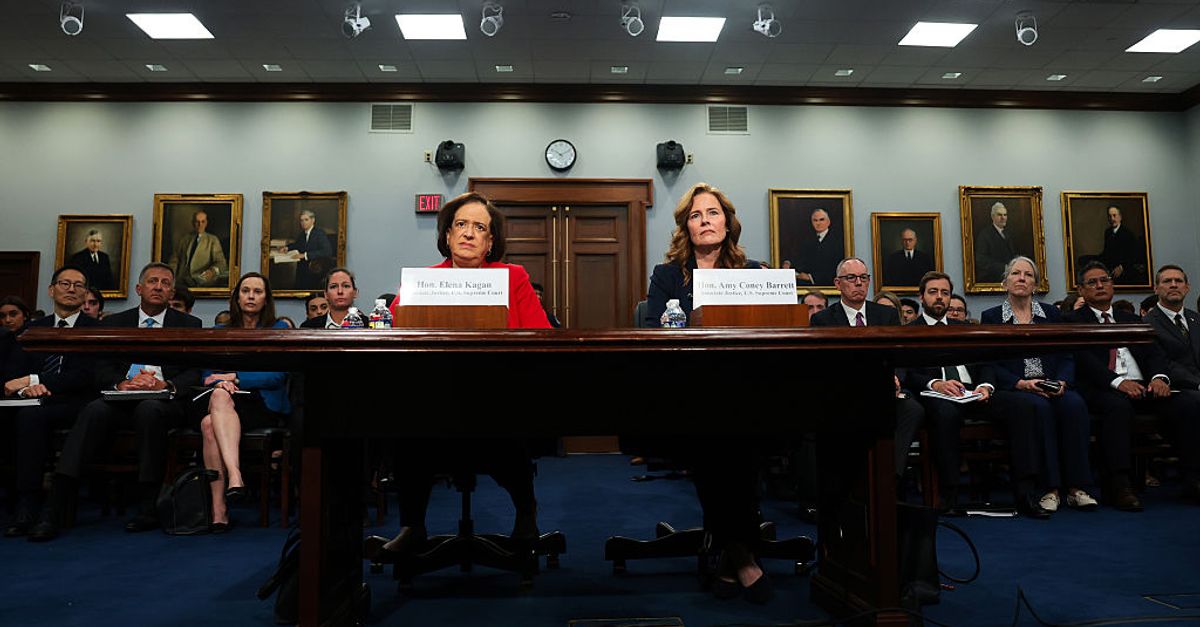
Justices Kagan and Barrett testify before Congress
Abstract
Justices Elena Kagan and Amy Coney Barrett recently testified before Congress, marking the first such appearances in seven years. Their testimony primarily addressed the Supreme Court's budget, which is projected to exceed $220 million in Fiscal Year 2027, with a significant portion allocated to enhanced security measures. The justices detailed the escalating threats faced by federal judges, particularly following the leak of the *Dobbs v. Jackson Women's Health Organization* opinion. Beyond financial matters, the discussion extended to the Court's recently adopted ethics code and the contentious use of its emergency, or "shadow," docket. This rare congressional engagement underscores growing concerns about judicial security, accountability, and the Court's procedural transparency, offering legal professionals critical insights into the operational challenges confronting the nation's highest court.
Introduction
In a rare and significant event, Supreme Court Justices Elena Kagan and Amy Coney Barrett appeared before congressional committees, providing testimony on a range of issues central to the Court's functioning and public perception. These appearances, the first by sitting justices before Congress in seven years, offered a unique glimpse into the internal workings and pressing concerns of the judicial branch. While ostensibly focused on the Court's annual budget appropriation, the dialogue quickly expanded to encompass critical areas such as judicial security, the enforcement of the Court's ethics code, and the controversial use of its emergency docket.
The justices' testimony comes at a time of heightened scrutiny and public debate surrounding the Supreme Court's legitimacy and operational transparency. The discussions highlighted the substantial increase in the Court's budget, driven predominantly by a dramatic surge in security expenses, a direct response to a more volatile public and political landscape. This article will delve into the specifics of their testimony, examining the statutory and doctrinal underpinnings of the issues raised, analyzing their implications for legal practice, and considering the broader impact on the federal judiciary.
Background
The Supreme Court, like other federal entities, relies on Congress for its annual budget appropriations, a process governed by Article I, Section 9, Clause 7 of the U.S. Constitution, known as the Appropriations Clause. This constitutional mandate ensures legislative oversight over federal spending, including that of the judiciary. The overall Judiciary's fiscal year 2027 discretionary budget request totals $9.7 billion, with a significant portion dedicated to the Supreme Court's operational needs.
A primary driver of the Supreme Court's recent budget increases has been the escalating need for judicial security. The U.S. Marshals Service is statutorily responsible for providing security for federal judges and the judicial process, as outlined in 28 U.S.C. § 566. Justice Kagan noted a stark contrast in security needs, recalling a time when personal security was largely limited to public events. The focus on security intensified following Justice Antonin Scalia's death in 2016 and saw a "big ramp-up" in 2022 after the unprecedented leak of the draft opinion in *Dobbs v. Jackson Women's Health Organization*, 597 U.S. 215 (2022).
In November, the Supreme Court adopted its first-ever Code of Conduct for Supreme Court Justices, a move that followed years of public pressure and ethical controversies involving individual justices. Prior to this, Supreme Court justices were not bound by a specific code of conduct, unlike lower federal court judges who adhere to the Code of Conduct for U.S. Judges. Another area of congressional inquiry was the Court's "emergency" or "interim" docket, commonly referred to as the "shadow docket." This docket handles applications for immediate action, often without oral arguments or extensive written explanations, and has drawn increasing criticism for its lack of transparency and perceived impact on substantive law.
Analysis
The testimony of Justices Kagan and Barrett underscored the profound impact of evolving societal and political dynamics on the practical administration of justice. The most striking revelation concerned the dramatic increase in the Supreme Court's budget, primarily driven by security expenses. Justice Kagan highlighted that the Court's budget, projected to exceed $220 million in FY 2027, has seen recent growth "almost entirely for security expenses." This surge reflects a tangible response to a significant rise in threats against federal judges, with the U.S. Marshals Service reporting hundreds of threats annually. The justices articulated a desire to transition towards in-house residential security, moving away from reliance on external contracts, indicating a permanent shift in the protective measures deemed necessary for their safety and that of their families. This heightened security environment, particularly post-*Dobbs*, has direct implications for the accessibility of judicial officers and the overall functioning of the federal judiciary.
The discussion around the Court's ethics code revealed an ongoing tension between internal self-regulation and external calls for greater accountability. While the Supreme Court adopted a Code of Conduct in November, critics argue it lacks robust enforcement mechanisms, relying primarily on self-policing by the justices. This contrasts with the binding nature and enforcement provisions applicable to lower federal judges under 28 U.S.C. § 455, which mandates recusal in cases where a judge's impartiality might reasonably be questioned. The debate continues regarding whether Congress possesses the constitutional authority to impose a binding ethics code on the Supreme Court, with some justices asserting that such legislation would infringe upon the separation of powers. For practitioners, this means navigating an ethical landscape where the highest court operates under a code whose practical application and enforceability remain subjects of considerable debate.
Furthermore, the justices addressed the contentious "shadow docket," which Justice Kagan prefers to call the "emergency" or "interim" docket. This expedited process, used for urgent applications, has been criticized for its increasing frequency, lack of transparency, and the minimal reasoning often provided in its decisions. Critics argue that the expanded use of the shadow docket, particularly since 2016, allows the Court to make significant legal pronouncements without the full briefing, oral arguments, and reasoned opinions characteristic of its merits docket. Justice Kagan acknowledged that the Court has recently made efforts to provide more expansive explanations for its emergency decisions, a response to criticisms from lower courts struggling to interpret sparse rulings. The implications for practitioners are significant, as shadow docket decisions, despite their abbreviated nature, can have immediate and far-reaching legal effects, potentially altering the legal landscape without the traditional precedential clarity.
Collectively, these issues—judicial security, ethical accountability, and docket transparency—converge on the fundamental principle of judicial independence and public trust. The need for enhanced security underscores the threats to the judiciary's ability to operate free from intimidation, while the ethics debate and shadow docket concerns highlight challenges to the public's confidence in the Court's impartiality and decision-making processes. The ongoing dialogue between the judicial and legislative branches reflects a critical juncture for the federal judiciary, as it seeks to balance its constitutional role with the demands for greater transparency and accountability in a polarized environment.
Conclusion
The recent testimony by Justices Kagan and Barrett before Congress provides invaluable insights into the contemporary challenges facing the U.S. Supreme Court. For legal practitioners, these discussions highlight several critical areas demanding attention. The significant increase in judicial security funding and the shift towards more robust protective measures underscore the evolving risks faced by federal judges, which can indirectly impact courtroom access and the broader judicial environment. Attorneys should remain cognizant of these security considerations in their interactions with the federal judiciary.
Furthermore, the ongoing debate surrounding the Supreme Court's ethics code and the transparency of its emergency docket necessitates a careful approach to legal strategy and advocacy. While the adoption of a Code of Conduct is a step towards greater accountability, its self-enforcement mechanism means that ethical considerations will remain a dynamic and potentially contentious area. Practitioners must also closely monitor the Court's use of the shadow docket, understanding that expedited, less-reasoned decisions can still carry significant precedential weight and immediate legal consequences. The dialogue initiated by these testimonies signals a continuing evolution in how the Supreme Court balances its constitutional duties with public expectations for transparency and accountability, making vigilance and adaptability key for all legal professionals.
Citations
- 1.Dobbs v. Jackson Women's Health Organization, 597 U.S. 215 (2022)
- 2.28 U.S.C. § 455
- 3.28 U.S.C. § 566
How does this affect your business?
Get an AI analysis of this article grounded in your jurisdictions, practice areas, and any policy documents you've uploaded to Wansom.