
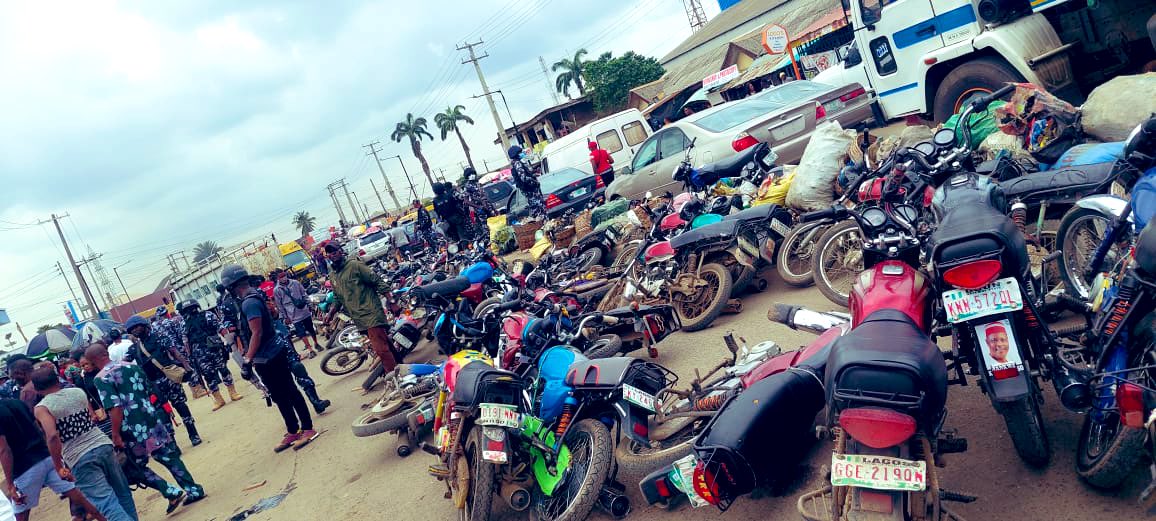
Lagos task force impounds 309 motorcycles
Abstract
The Lagos State Task Force recently impounded 309 commercial motorcycles along the Lagos-Badagry Expressway, reinforcing the state government's sustained efforts to enforce traffic and environmental regulations. This action is rooted in the Lagos State Transport Sector Reform Law 2018 and the earlier Lagos State Road Traffic Law 2012, which prohibit commercial motorcycles (Okada) from operating on major highways and in designated local government areas. The impoundment and subsequent forfeiture through the courts are aimed at enhancing road safety, reducing traffic congestion, and curbing criminal activities often associated with unregulated motorcycle operations. The continuous enforcement underscores the state's commitment to public order despite persistent defiance from some operators.
Introduction
The recent impoundment of 309 commercial motorcycles by the Lagos State Task Force along the Lagos-Badagry Expressway marks another significant step in the Lagos State Government's ongoing campaign to restore sanity to its roads and enhance public safety. This enforcement action is not an isolated event but rather a continuation of a long-standing policy aimed at regulating the operations of commercial motorcycles, popularly known as 'Okada', within the state. The Lagos-Badagry Expressway is one of several major thoroughfares where the operation of commercial motorcycles is expressly prohibited, reflecting the government's resolve to curb traffic infractions and associated criminalities.
This development holds substantial implications for legal practitioners, particularly those involved in administrative law, transportation law, and criminal defence. It highlights the state's reliance on existing legislative frameworks to address persistent urban challenges, including road safety, traffic management, and security. The article will delve into the legal basis for these impoundments, the historical context of motorcycle bans in Lagos, and the procedural aspects of forfeiture, providing a comprehensive overview for legal professionals navigating this complex regulatory landscape.
Background
The regulation of commercial motorcycles in Lagos State has a history spanning over a decade, driven by concerns over road accidents, traffic congestion, and their use in criminal activities. The foundational legislation in this regard is the Lagos State Road Traffic Law, 2012. This law, signed by then-Governor Babatunde Raji Fashola, SAN, introduced significant restrictions, including a ban on motorcycles with engine capacities below 200cc from operating on bridges and major carriage roads. It also specified routes where motorcycles were prohibited, such as the Lagos-Badagry Expressway, and mandated operating hours between 6:00 a.m. and 8:00 p.m. in permitted areas.
Building upon this, the Lagos State Transport Sector Reform Law, 2018, further solidified and expanded these restrictions. Section 46(1) of the 2018 Law explicitly prohibits any person from riding, driving, or propelling a motorcycle or tricycle on a major highway within the state. Contravention of this provision carries severe penalties, including imprisonment for a term of three years and the forfeiture of the motorcycle or tricycle to the State. Subsequent administrations, including the current one, have consistently reiterated and expanded the ban, notably in 2020 and 2022, to cover specific Local Government Areas (LGAs) and Local Council Development Areas (LCDAs) such as Apapa, Lagos Mainland, Surulere, Ikeja, Eti-Osa, and Lagos Island, alongside all major highways and bridges.
Analysis
The enforcement actions by the Lagos State Task Force are directly underpinned by the provisions of the Lagos State Transport Sector Reform Law, 2018. The law grants the state government the authority to restrict and ban the operation of commercial motorcycles on designated routes and areas. The Lagos-Badagry Expressway, where the recent impoundments occurred, falls squarely within the category of prohibited major highways. The rationale for these bans, as consistently articulated by state authorities, extends beyond mere traffic management to encompass broader public safety and security concerns. High accident rates involving commercial motorcycles, often resulting in fatalities and severe injuries, and their documented use as getaway vehicles in criminal activities, are frequently cited justifications.
While the legal framework for the ban is clear, its implementation has faced challenges, including persistent defiance from operators and occasional clashes with enforcement agents. The law provides for the forfeiture of impounded motorcycles through the courts, ensuring a judicial process for the final disposition of seized assets. This judicial oversight is crucial for upholding due process and preventing arbitrary confiscation. However, the sheer volume of impounded vehicles often strains the judicial and administrative systems, raising questions about the efficiency and transparency of the forfeiture process.
Comparative analysis with other jurisdictions reveals similar attempts to regulate or ban commercial motorcycles in rapidly urbanising environments, often with mixed results. The balance between public safety and the economic livelihoods of operators remains a contentious issue. In Lagos, the government has attempted to provide alternatives, such as vocational training and public transportation initiatives, to mitigate the socio-economic impact on affected riders. Nonetheless, the continued prevalence of 'Okada' on restricted routes indicates a persistent gap between policy intent and on-ground compliance, suggesting the need for a multi-faceted approach that combines robust enforcement with sustainable alternative livelihood programmes and improved public transport infrastructure.
The Lagos State Environmental and Special Offences (Enforcement) Unit (Task Force) operates under the Ministry of the Environment and Water Resources, with powers that extend to environmental infractions and public order, in addition to traffic enforcement. Their collaboration with the Lagos State Police Command in these operations further strengthens the enforcement capacity, aiming to tackle not just traffic violations but also associated criminal elements. The ongoing nature of these operations, as indicated by the Task Force, signals a sustained commitment to achieving full compliance with the extant laws.
Conclusion
The impoundment of 309 motorcycles on the Lagos-Badagry Expressway serves as a stark reminder to commercial motorcycle operators and the public of the Lagos State Government's unwavering commitment to enforcing its traffic laws. Legal practitioners should advise clients, both operators and passengers, on the severe penalties for contravening the Lagos State Transport Sector Reform Law, 2018, which include imprisonment and the forfeiture of vehicles. The consistent application of these laws, despite public outcry and operational challenges, indicates a firm stance by the state authorities.
Practitioners should closely monitor judicial pronouncements regarding the forfeiture process to ensure that due process is strictly adhered to. Furthermore, the broader implications for urban mobility and the informal economy warrant attention. While the state government's objectives of enhancing safety and security are laudable, the socio-economic impact on operators and commuters necessitates a continuous dialogue and the exploration of sustainable alternatives. The ongoing enforcement actions suggest that the legal landscape for commercial motorcycle operations in Lagos will remain stringent, requiring all stakeholders to operate strictly within the confines of the law.
Citations
- 1.Lagos State Road Traffic Law, 2012
- 2.Lagos State Transport Sector Reform Law, 2018
How does this affect your business?
Get an AI analysis of this article grounded in your jurisdictions, practice areas, and any policy documents you've uploaded to Wansom.