
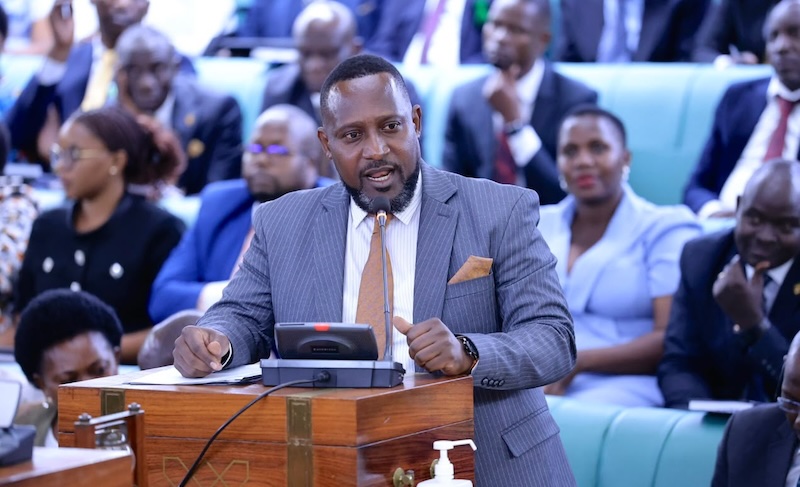
MP Namara granted leave to introduce amendments to clip LoP Ssenyonyi’s powers
Abstract
Uganda's Parliament has granted Buyaga West MP Dennis Namara leave to introduce a Private Member’s Bill aimed at amending the Administration of Parliament Act, Cap 257. The proposed amendments seek to alter the method of electing the Leader of the Opposition (LoP), moving from nomination by the largest opposition party to an election by all opposition and independent Members of Parliament. Furthermore, the Bill intends to expand the grounds for the LoP's removal to include incompetence and misconduct, thereby enhancing accountability. This legislative initiative has sparked significant debate regarding its potential impact on parliamentary democracy, party autonomy, and the established framework for checks and balances within Uganda's multiparty political system.
Introduction
The Ugandan Parliament recently became the arena for a renewed debate on the powers and accountability of the Leader of the Opposition (LoP), following the grant of leave to Buyaga West MP Dennis Namara to introduce a Private Member’s Bill. This Bill seeks to amend the Administration of Parliament Act, Cap 257, a move that could fundamentally reshape the operational dynamics of the opposition in Uganda’s legislative landscape. The decision to grant leave, made after a procedural debate, signals the commencement of a legislative process that promises to be both legally intricate and politically charged.
At the heart of the proposed amendments lies a desire to revise how the LoP is chosen and held accountable, challenging the existing framework where the largest opposition party primarily dictates the appointment. Proponents argue that these changes will foster greater internal democracy and accountability within the opposition bloc. However, critics express concerns about potential implications for party autonomy and the integrity of the multiparty system, suggesting that such reforms could inadvertently weaken the opposition's effectiveness in scrutinizing the government.
This article delves into the statutory and doctrinal context surrounding the LoP's office in Uganda, analyzes the specific amendments proposed by MP Namara, and explores the broader legal and political ramifications for parliamentary governance and the separation of powers. It aims to provide legal practitioners with a comprehensive understanding of the ongoing legislative development and its potential impact on Uganda’s constitutional democracy.
Background
The Office of the Leader of the Opposition in Uganda is a creature of statute, formally established by Article 82A of the Constitution of the Republic of Uganda, 1995, as amended, and operationalized by the Administration of Parliament (Amendment) Act, 2006. Prior to the 2005 constitutional amendments that restored multiparty politics, the role of the opposition was less formally entrenched. The 2006 amendment to the Administration of Parliament Act, Cap 257, specifically provided for the inclusion of the Leader of the Opposition in the Parliamentary Commission and outlined the manner of choosing, ceasing to hold office, status, role, functions, and benefits attached to the office.
Under the current legal framework, the Leader of the Opposition is defined as the leader in Parliament of the party in opposition to the Government having the greatest numerical strength. This party nominates its leader, and the Speaker of Parliament formally announces the nominee to the House. The LoP holds a status equivalent to that of a Cabinet Minister, enjoying similar benefits and privileges, including an official vehicle, security escorts, and a budget for office administration. The principal role of the LoP is to keep the government in check, which is achieved by appointing and heading a Shadow Cabinet whose members hold portfolios mirroring those of government ministers, and by actively participating in parliamentary committees and debates to offer alternative policies and scrutinize government actions.
Crucially, the existing legal architecture provides limited mechanisms for the removal of the LoP by Parliament itself. The office typically falls vacant if the holder resigns, ceases to be an MP, is replaced by the nominating party, or if another opposition party gains the largest numerical strength. This framework underscores the principle of party autonomy in determining its leadership, a cornerstone of the multiparty system envisioned by the Constitution.
Analysis
MP Dennis Namara's proposed Administration of Parliament (Amendment) Bill, 2026, directly challenges the established method of selecting and removing the Leader of the Opposition. The core amendments seek to shift the power of election from the largest opposition political party to a broader electorate comprising all opposition Members of Parliament, including independent members. This proposal is premised on the argument that the current system concentrates excessive authority within a single party and limits internal democratic participation, thereby creating an accountability deficit.
Furthermore, the Bill proposes to expand the grounds for the removal of the LoP to explicitly include incompetence and misconduct. Currently, the LoP can primarily be removed by their nominating party, or if they cease to be an MP or their party loses its numerical strength. Supporters of the Bill contend that, given the LoP's significant status and access to public funds—equivalent to a Cabinet Minister—there should be more robust parliamentary oversight and mechanisms for removal, akin to those applicable to other parliamentary office bearers like the Speaker or Cabinet Ministers.
The procedural debate preceding the grant of leave highlighted key aspects of Uganda's legislative process. Deputy Speaker Thomas Tayebwa clarified that at the leave stage, the Chair's role is limited to ensuring the proposed Bill complies with constitutional requirements, particularly Articles 79 and 94, and the Rules of Procedure, rather than assessing its merits. He also affirmed that a Certificate of Financial Implications is not required until the Bill is tabled for its first reading, after it has been drafted. Opposition legislators raised concerns about revisiting proposals similar to those considered in previous Parliaments, and questioned the political motivations behind the Bill, but these were deemed matters for substantive debate rather than grounds to deny leave.
The proposed amendments carry significant legal implications for Uganda's multiparty democracy and the doctrine of separation of powers. While the Ugandan Constitution delineates powers among the executive, legislative, and judicial branches, there is an inherent fusion of personnel, particularly between the executive and legislature. The LoP's role, as an institutionalized check on the executive, is vital. Shifting the election mechanism could dilute the nominating party's authority and potentially create a LoP less beholden to party discipline, but also potentially more susceptible to broader parliamentary influence, including from the ruling party or independent members. This contrasts with the Westminster system, which Uganda largely draws from, where the Leader of the Opposition is typically the leader of the largest non-government party and is seen as an 'alternative Prime Minister,' with their position intrinsically linked to their party's electoral mandate.
Moreover, the introduction of incompetence and misconduct as grounds for removal could introduce a new layer of political vulnerability for the LoP, potentially exposing the office to politically motivated challenges. This is not the first attempt to amend the Administration of Parliament Act in this regard; a remarkably similar Bill was introduced by Richard Lumu in 2024, which also sought to require opposition MPs to elect the LoP and proposed additional removal mechanisms. The recurrence of such proposals underscores persistent tensions regarding the LoP's independence and accountability within Uganda's political framework.
Conclusion
The granting of leave to MP Dennis Namara to introduce amendments to the Administration of Parliament Act marks a critical juncture for Uganda's parliamentary democracy. The proposed changes, particularly concerning the election and removal of the Leader of the Opposition, have far-reaching implications for the balance of power within Parliament and the efficacy of the opposition's oversight function. Legal practitioners, especially those specializing in constitutional law, parliamentary procedure, and political governance, must closely monitor the progression of this Bill.
As the Bill moves through the legislative stages—including drafting, obtaining a certificate of financial implications, committee scrutiny, and eventual debate—its specific provisions will become clearer, and the legal arguments for and against its enactment will intensify. The potential for legal challenges, particularly regarding constitutional principles of multiparty democracy and party autonomy, remains high. Stakeholders are advised to engage actively in the public discourse and legislative process to ensure that any reforms ultimately strengthen, rather than undermine, the institutional integrity and democratic safeguards of Uganda's Parliament.
Citations
- 1.The Constitution of the Republic of Uganda, 1995
- 2.Administration of Parliament Act, Cap 257
- 3.Administration of Parliament (Amendment) Act, 2006
- 4.The Observer Uganda, "MP Namara granted leave to introduce amendments to clip LoP Ssenyonyi’s powers" (July 9, 2026)
- 5.Nilepost, "De Brief: Who Owns the Leader of the Opposition? And Who Should?" (June 29, 2026)
- 6.Grokipedia, "Leader of the Opposition"
- 7.Parliament of Uganda, "The Office of the Leader of the Opposition"
- 8.Uganda Legal Information Institute (ULII), "Administration of Parliament Act, Chapter 257" (November 6, 2025)
- 9.URN, "Namara granted leave to introduce Amendments on LOP powers" (July 9, 2026)
- 10.Nilepost, "Parliament to Consider Namara's Administration of Parliament Amendment Bill" (July 8, 2026)
- 11.Parliament of Vanuatu, "ROLES OF THE LEADER OF OPPOSITION"
- 12.Scribd, "Separation of Powers in Uganda's Law"
- 13.Parliament Watch Uganda, "PLU Faces Legal Wall in Bid to Oust Opposition Leader Joel Ssenyonyi" (June 19, 2026)
- 14.Parliament Watch Uganda, "Who Will Lead Uganda's Opposition Next?" (March 19, 2026)
- 15.Uganda Radio Network, "Uganda : Parliament Approves Introduction of Bill to Reform Election of Leader of Opposition" (July 8, 2026)
- 16.YouTube, NTV Uganda, "PLU MPs Table Private Member's Bill to Amend Parliament Administration Act" (June 25, 2026)
- 17.Wikipedia, "Leader of the Opposition"
- 18.Parliament Watch Uganda, "MP Namara to Seek Leave to Introduce Bill on Opposition Leadership Selection Rules" (July 6, 2026)
- 19.LDC Publishers, "The Administration of Parliament Act Cap. 257 / Uganda" (1962)
- 20.Scribd, "Uganda's Separation of Powers Explained"
- 21.YouTube, NTV Uganda, "LEADER OF OPPOSITION: What is the office entitled to?" (December 22, 2023)
- 22.Scribd, "Private Member's Bill Process in Uganda"
- 23.The Independent Uganda, "Ssenyonyi hands over Leader of Opposition office" (May 16, 2026)
- 24.Parliament of Uganda, "How a Bill Becomes a Law - Kampala"
- 25.First Parliamentary Counsel, "MANUAL ON THE LEGISLATIVE PROCESS IN UGANDA" (March 2014)
- 26.ConstitutionNet, "Constitutional history of Uganda" (July 14, 2025)
- 27.Wikipedia, "Westminster system"
- 28.Judiciary, "1 Administration of Parliament Act 22 (Amendment) Act 2006" (August 4, 2006)
- 29.Kampala Associated Advocates (KAA), "This Is Why The Doctrine Of Separation Of Powers Is Constitutionally Archaic" (June 8, 2020)
- 30.YouTube, NTV Uganda, "Doctrine of separation of powers in Uganda | MorningAtNTV" (February 4, 2025)
- 31.Parliament of Uganda, "Administration of Parliament"
- 32.Parliament of Uganda, "The Administration of Parliament (Amendment) Bill, 2021"
- 33.NTV Uganda, "ADMINISTRATION OF PARLIAMENT: More questions linger on proposed changes" (June 24, 2026)
- 34.Parliament of Australia, "The (official) Opposition"
- 35.allAfrica.com, "Uganda: Plu-Backed MPs Seek to Oust Leader of the Opposition" (June 24, 2026)
How does this affect your business?
Get an AI analysis of this article grounded in your jurisdictions, practice areas, and any policy documents you've uploaded to Wansom.