
Police justify approach to Bobe murder investigation
Abstract
The ongoing murder trial of Dr. Victoria Bobe in Malawi has brought to the fore critical aspects of criminal procedure and evidence, particularly concerning the police's investigative approach. Despite not recovering the weapons allegedly used in the crime, the Malawi Police Service has justified its arrests, insisting the right suspects are in custody. This article examines the legal framework governing criminal investigations in Malawi, focusing on the implications of missing physical evidence, the standard of proof, and the role of circumstantial evidence. It further delves into the constitutional presumption of innocence and the challenges faced by the prosecution in securing a conviction in the absence of direct physical evidence, highlighting the rigorous evidentiary standards required in the Malawian High Court.
Introduction
The high-profile murder trial of medical doctor Victoria Bobe in Malawi continues to draw national attention, not least due to the police's staunch defence of their investigative methods. During re-examination before High Court Judge Ruth Chinangwa, Assistant Superintendent Christopher Pangeti, the State’s third witness, asserted that investigators arrested the correct suspects, even without recovering the weapons allegedly used in the commission of the crime. This stance has ignited debate among legal practitioners regarding the sufficiency of evidence and adherence to established criminal procedure in the Malawian justice system.
This article aims to dissect the legal implications of the police's justification, particularly in the context of Malawian criminal law and evidence. It will explore the statutory and doctrinal underpinnings that guide murder investigations, the evidentiary hurdles faced by the prosecution when key physical evidence is absent, and the constitutional safeguards afforded to accused persons. The Bobe case serves as a critical lens through which to examine the practical application of these legal principles and their potential impact on the administration of justice in Malawi.
Background
Malawi's legal system is fundamentally rooted in English common law, adapted and developed through its Constitution, statutes, and judicial precedents. The primary legislative instruments governing criminal proceedings are the Constitution of the Republic of Malawi, the Criminal Procedure and Evidence Code (Cap. 8:01) (CPEC), and the Penal Code (Cap. 7:01). The Constitution, as the supreme law, enshrines fundamental human rights, including the presumption of innocence until proven guilty (Section 42(2)(f)(iii)) and the right to a fair trial (Section 42(2)(g)).
The Malawi Police Service operates under the mandate of the Police Act (No. 12 of 2010, also Cap. 13:01), which outlines its organisation, administration, powers, and duties. The CPEC provides the framework for arrests, detention, and the collection and presentation of evidence in criminal cases. Serious crimes, such as murder, are tried in the High Court, which possesses unlimited original jurisdiction in both civil and criminal matters. The standard of proof in all criminal cases in Malawi is 'beyond a reasonable doubt,' a high threshold that requires the prosecution to present evidence so cogent and compelling as to leave only a remote possibility in the accused's favour.
Analysis
The police's assertion that they arrested the 'right suspects' despite not recovering the murder weapons raises significant questions regarding the nature and sufficiency of evidence required for a conviction in Malawi. While the recovery of a murder weapon provides strong direct evidence, its absence is not necessarily fatal to the prosecution's case. Malawian law, drawing from common law principles, permits conviction based on circumstantial evidence, provided that such evidence is so compelling that no rational hypothesis other than the accused's guilt is possible, leaving the court in no reasonable doubt. This principle was articulated in *Republic v Jailosi, High Court Cr. Case No. 82 of 1968*, which held that the fact of a killing can be proved by circumstantial evidence if it is sufficiently cogent and compelling.
However, the reliance on circumstantial evidence places a heavier burden on the prosecution to meticulously piece together a narrative that excludes all other reasonable inferences. The CPEC outlines various forms of evidence, including oral, documentary, and real evidence, all of which must be admissible, relevant, and reliable. In the Bobe trial, the State has lined up nine witnesses, including the widower, whose emotional testimony recounted the events of the night. Such oral testimony, combined with forensic findings and any confessions, would form the bulk of the prosecution's case.
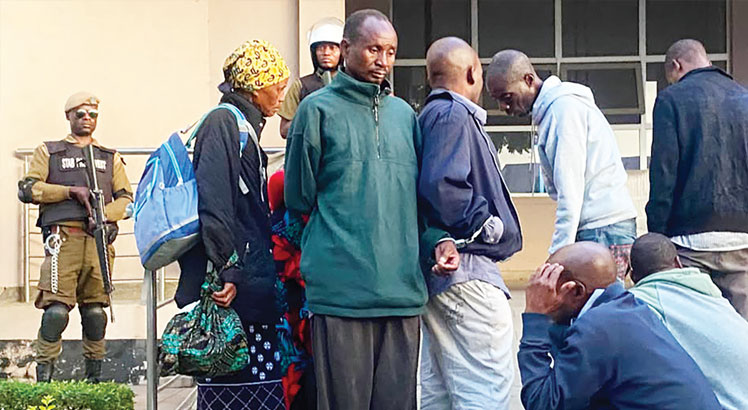
Concerns have also been raised by legal practitioners regarding the police's public parading of suspects and crime scene narrations in the Bobe case. Such actions risk undermining the constitutional presumption of innocence and could potentially prejudice the trial by creating a perception of guilt before judicial determination. While police reported that some suspects provided explicit confessions, the admissibility and voluntariness of such confessions, especially when made in public or without legal representation, are subject to stringent scrutiny by the courts.
Furthermore, the widower's testimony highlighted the challenge of establishing 'malice aforethought' for the murder charge, given his inability to discern a clear motive beyond theft. Malice aforethought is a crucial element of murder under the Penal Code, and its proof often relies on inferential reasoning from the circumstances of the killing. The court, presided over by Justice Ruth Chinangwa, will need to carefully weigh all evidence presented, including the emotional testimony, forensic findings, and any confessions, against the strict legal requirements for proving murder and the associated offences beyond a reasonable doubt.
Conclusion
The Dr. Victoria Bobe murder trial serves as a critical examination of Malawi's criminal justice system, particularly concerning the delicate balance between effective law enforcement and the protection of constitutional rights. For legal practitioners, this case underscores the enduring principle that the absence of direct physical evidence, such as a murder weapon, does not automatically preclude a conviction, provided the circumstantial evidence presented by the prosecution meets the stringent standard of proof beyond a reasonable doubt. However, it also highlights the heightened scrutiny that courts apply to such cases, demanding a coherent and compelling evidentiary chain that leaves no room for reasonable alternative hypotheses.
Practitioners must remain vigilant in challenging investigative methods that could compromise the fairness of a trial, such as public parades of suspects, which may infringe upon the presumption of innocence and the right to a fair hearing. The outcome of this trial will undoubtedly set important precedents for future murder investigations and prosecutions in Malawi, reinforcing the need for meticulous adherence to the Criminal Procedure and Evidence Code and the Constitution. It is a stark reminder that justice, while demanded by the public, must always be delivered through lawful and procedurally sound means.
Citations
- 1.Constitution of the Republic of Malawi, 1994
- 2.Criminal Procedure and Evidence Code (Cap. 8:01)
- 3.Penal Code (Cap. 7:01)
- 4.Police Act, No. 12 of 2010
- 5.Republic v Jailosi, High Court Cr. Case No. 82 of 1968 (unreported)
How does this affect your business?
Get an AI analysis of this article grounded in your jurisdictions, practice areas, and any policy documents you've uploaded to Wansom.