
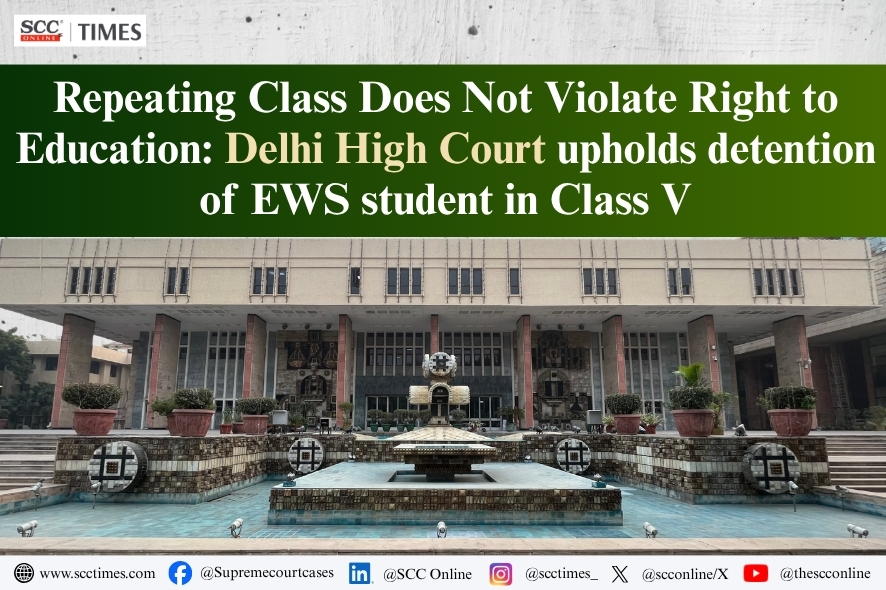
Repeating Class Does Not Violate Right to Education: Delhi High Court upholds detention of EWS student in Class V
Abstract
The Delhi High Court has upheld the detention of an Economically Weaker Section (EWS) student in Class V, ruling that repeating a class does not violate the right to education under the Right to Education Act (RTE). The court held that repeated academic support may be necessary for foundational learning and directed the school to continue all EWS entitlements. This decision highlights the balance between ensuring students meet academic standards and protecting their rights.
Introduction
The Delhi High Court has delivered a significant ruling in a case involving an EWS student who was detained in Class V, sparking debate about the implications for education policy. The court's decision to uphold the detention has been welcomed by some as a necessary measure to ensure students meet academic standards, while others have expressed concerns that it may infringe on the right to education. This article examines the key aspects of the ruling and its potential impact on education law in India.
Background
The Right to Education Act (RTE) guarantees free and compulsory education to all children between the ages of 6 and 14. However, Section 16 of the RTE allows for the detention of students who fail to meet academic standards, provided that repeated academic support is offered. The Delhi High Court's ruling in this case has shed light on the interpretation of this provision and its implications for EWS students.
Analysis
The court's decision to uphold the detention of the EWS student was based on the principle that repeating a class may be necessary for foundational learning. This approach acknowledges that some students may require additional support to meet academic standards, while also ensuring that they are not unfairly disadvantaged by being held back. The ruling has been welcomed by education experts who argue that it strikes a balance between protecting students' rights and ensuring that they meet academic standards.
Conclusion
The Delhi High Court's ruling in this case highlights the complexities of balancing individual student needs with broader educational goals. As education policymakers grapple with these issues, this decision provides valuable insights into the interpretation of the RTE Act and its implications for EWS students. Practitioners should be aware of the court's approach to interpreting Section 16 of the RTE and its potential impact on future cases involving student detention.
How does this affect your business?
Get an AI analysis of this article grounded in your jurisdictions, practice areas, and any policy documents you've uploaded to Wansom.