
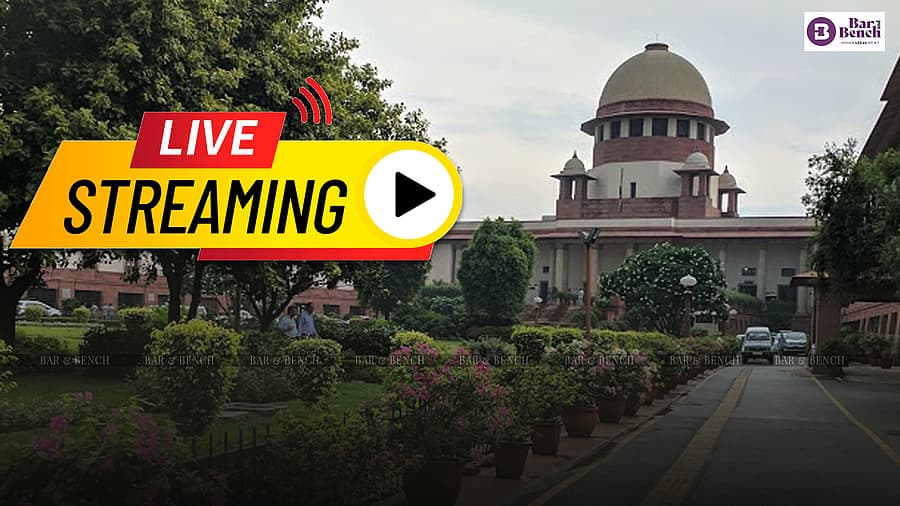
Supreme Court restrains posting, circulating clips of live-streamed court hearings without permission
Abstract
The Supreme Court of India has passed an interim order restricting the unauthorized use or circulation of live-streamed court proceedings on social media and other digital platforms without prior permission. The order, which does not affect news reporting, was passed by a Bench comprising Chief Justice Surya Kant and Justices Joymalya Bagchi and V Mohana while considering a plea seeking restraint on the unauthorized extraction and monetization of videos of court proceedings. As an interim measure, the Court has directed that no posting, reposting, extraction, modification, dissemination, monetization, recording or review of live-streamed proceedings shall be done without prior permission from the concerned Registrar and Secretary General of the Supreme Court.
Introduction
The Supreme Court of India has passed an interim order prohibiting the unauthorized use or circulation of live-streamed court hearings on social media and other digital platforms. The order, which was passed by a Bench comprising Chief Justice Surya Kant and Justices Joymalya Bagchi and V Mohana, is a significant development in the ongoing debate about the regulation of online content related to court proceedings. As the use of social media and live-streaming technologies continues to grow, courts around the world are grappling with how to balance the need for transparency and access to justice with the potential risks of unauthorized sharing and misuse of sensitive information.
Background
The Supreme Court's order is a response to concerns about the misuse of videos of court hearings on social media. The Court has clarified that its order will not affect news reporting, which is an important exception in this context. News organizations have a long-standing tradition of reporting on court proceedings, and their ability to do so freely is essential for ensuring transparency and accountability in the administration of justice. However, the unauthorized sharing or monetization of videos of court hearings can compromise the integrity of the judicial process and undermine public trust in the courts.
Analysis
The Supreme Court's interim order raises important questions about the regulation of online content related to court proceedings. While the order is intended as a temporary measure, it highlights the need for more comprehensive rules and guidelines governing the use of social media and live-streaming technologies in the context of court hearings. The Court has also sought reports from the High Courts on the adoption of rules to regulate the live-streaming of courtroom hearings, which suggests that this issue will continue to be a priority in the coming months.
Conclusion
The Supreme Court's interim order restricting the unauthorized use or circulation of live-streamed court proceedings is an important development in the ongoing debate about the regulation of online content related to court hearings. As courts around the world grapple with how to balance transparency and access to justice with the potential risks of unauthorized sharing and misuse, this order provides valuable guidance on the need for more comprehensive rules and guidelines governing the use of social media and live-streaming technologies.
How does this affect your business?
Get an AI analysis of this article grounded in your jurisdictions, practice areas, and any policy documents you've uploaded to Wansom.