
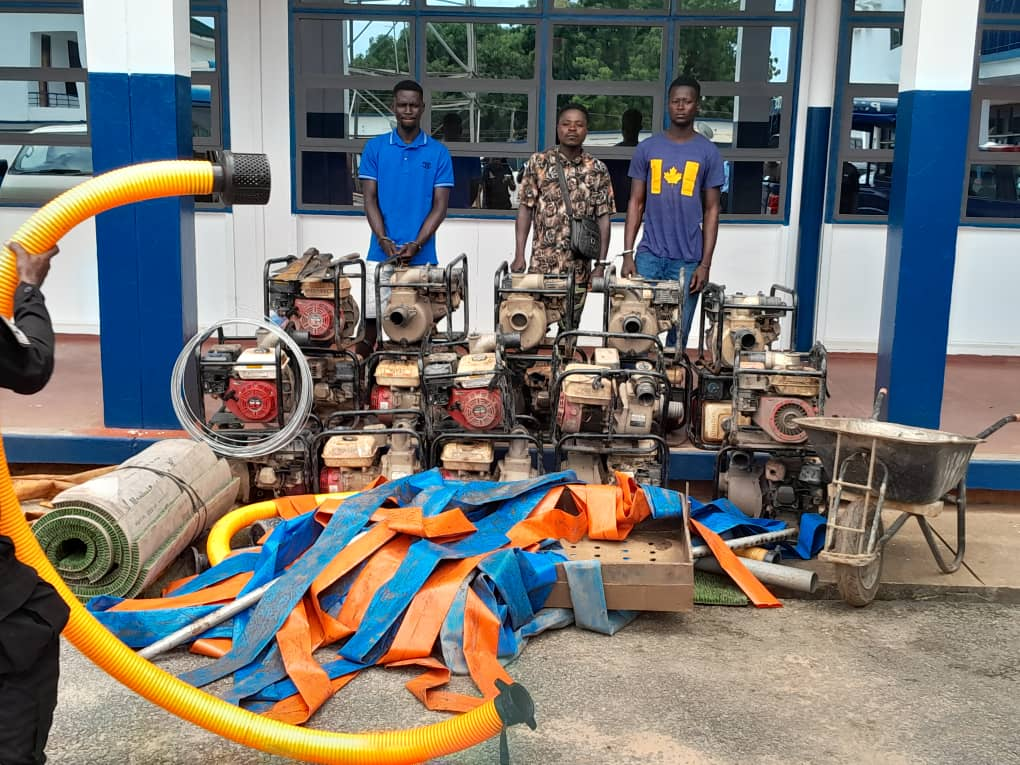
3 arrested as police storm galamsey site on Ghana Water pipeline at Efutu
Abstract
The recent arrest of three individuals for illegal mining (galamsey) near a Ghana Water Limited (GWL) pipeline at Efutu highlights Ghana's intensified efforts to combat illicit mineral extraction and protect critical national infrastructure. This incident underscores the severe legal ramifications under the Minerals and Mining Act, 2006 (Act 703), as amended, which prescribes stringent penalties, including lengthy imprisonment and substantial fines, for engaging in unauthorized mining activities. The arrests also bring into focus the broader legal framework encompassing water resource management and environmental protection, emphasizing the multi-jurisdictional nature of offences related to galamsey and the government's commitment to safeguarding public assets and natural resources from degradation.
Introduction
The Central Regional Police Command's recent apprehension of three persons engaged in illegal mining, locally known as 'galamsey', along a vital Ghana Water Limited (GWL) pipeline at Efutu, near Cape Coast, serves as a stark reminder of the persistent threat posed by illicit mining activities to Ghana's critical infrastructure and environment. This incident is not merely a localized law enforcement action but a significant development within the broader national campaign against galamsey, which has long plagued the nation's water bodies, forests, and public utilities. The location of the illegal operation, directly impacting a GWL pipeline, elevates the severity of the offence, transforming it from a general mining infraction into a matter of national security and public health.
This article delves into the legal framework underpinning the fight against illegal mining in Ghana, particularly as it pertains to the protection of essential infrastructure. It will examine the relevant provisions of the Minerals and Mining Act, 2006 (Act 703), as amended, the Water Resources Commission Act, 1996 (Act 522), and the Environmental Protection Agency Act, 1994 (Act 490). By analyzing the statutory provisions and the heightened penalties introduced through recent amendments, this piece aims to provide legal professionals with a comprehensive understanding of the legal landscape, the potential charges, and the implications for those involved in or affected by illegal mining activities near critical state assets.
Background
The legal foundation for mining in Ghana is primarily enshrined in the 1992 Constitution, which declares that all minerals in their natural state, whether in, under, or upon land, rivers, streams, or watercourses, are the property of the Republic and are vested in the President in trust for the people of Ghana. This constitutional provision is operationalized by the Minerals and Mining Act, 2006 (Act 703), which consolidates the laws relating to minerals and mining. The Act establishes the regulatory framework for mineral rights, licensing, and operations, distinguishing between large-scale and small-scale mining. Historically, 'galamsey' referred to traditional small-scale mining but has evolved to encompass all unauthorized gold mining, regardless of scale or operator.
Recognizing the devastating environmental and socio-economic impact of galamsey, the Ghanaian government has progressively strengthened its legal and enforcement mechanisms. Significant amendments to Act 703 were introduced through the Minerals and Mining (Amendment) Act, 2015 (Act 900), and more notably, the Minerals and Mining (Amendment) Act, 2019 (Act 995). These amendments were specifically designed to impose stiffer penalties, criminalize aiding and abetting illegal mining, and explicitly prohibit the use of equipment for mining in water bodies. Beyond mining-specific legislation, the Water Resources Commission Act, 1996 (Act 522), establishes the Water Resources Commission (WRC) as the primary body responsible for the regulation and management of Ghana's water resources, prohibiting unauthorized water use and mandating pollution control. Complementing these, the Environmental Protection Agency Act, 1994 (Act 490), (now superseded by the Environmental Protection Act 2025 (Act 1124)), provides the overarching framework for environmental protection, requiring environmental impact assessments and enforcing compliance with environmental standards.
Analysis
The arrests at Efutu will likely trigger charges under multiple legislative instruments, primarily the Minerals and Mining Act, 2006 (Act 703), as amended by Act 995. Section 99 of Act 703, as substituted by Act 995, explicitly criminalizes undertaking a mining operation without a license granted by the Minister. For Ghanaian citizens, this offence carries a severe penalty on summary conviction: a fine of not less than ten thousand penalty units and not more than fifteen thousand penalty units, coupled with a term of imprisonment of not less than fifteen years and not more than twenty-five years. The Act also specifically criminalizes the use of equipment for mining, dredging, or obtaining minerals in or along the banks of a natural water body, including a river, stream, or watercourse. The proximity to a Ghana Water Limited pipeline further exacerbates the gravity of the offence, potentially leading to additional charges related to damage to public property or endangering public safety.
Furthermore, the Water Resources Commission Act, 1996 (Act 522), plays a critical role in this context. Section 12 of Act 522 prohibits the use of water resources without prior authorization and the grant of water use rights from the Water Resources Commission. Illegal mining activities invariably involve the unauthorized abstraction and pollution of water bodies, directly contravening the provisions of this Act. The Environmental Protection Agency Act, 1994 (Act 490), also provides a basis for prosecution, as illegal mining operations typically cause significant environmental degradation, including water pollution and land destruction, without the requisite environmental permits or impact assessments.
The government's resolve to combat galamsey has been evident through various initiatives, including the establishment of the Inter-Ministerial Committee on Illegal Mining (IMCIM) and the National Anti-Illegal Mining Operations Secretariat (NAIMOS). The President has also assented to the Minerals and Mining (Amendment) Act, 2019 (Act 995), specifically to remove judicial discretion in sentencing, ensuring that convicted illegal miners face the prescribed minimum sentences. This legislative intent underscores the seriousness with which such offences are now treated. The proposed establishment of special courts for the speedy prosecution of galamsey cases further signals a zero-tolerance approach and an intent to ensure swift justice.
The challenge, however, lies not only in arrests but in successful prosecutions and the effective confiscation of equipment. While Act 900 provided for the confiscation of equipment used in illegal small-scale mining, the practicalities of storage and disposal have sometimes been problematic. The current legal framework aims to address these gaps, ensuring that the forfeiture of equipment serves as a significant deterrent. The involvement of a GWL pipeline also raises the potential for civil claims for damages by the Ghana Water Company Limited, a state-owned entity responsible for urban water supply, to recover costs associated with repairs, environmental remediation, and disruption of services.
Conclusion
The arrests at Efutu represent a tangible outcome of Ghana's sustained legal and enforcement campaign against illegal mining, particularly where it threatens vital public infrastructure. For legal practitioners, this incident highlights the critical importance of understanding the multi-layered regulatory framework governing mining, water resources, and environmental protection in Ghana. Individuals and entities involved in any aspect of mining must ensure strict compliance with the Minerals and Mining Act, 2006 (Act 703), as amended, and related environmental and water resource legislation, as the penalties for non-compliance are severe and increasingly enforced.
Practitioners advising clients in the mining sector, or those affected by illegal mining, must be acutely aware of the heightened penalties under Act 995, the potential for multi-agency enforcement actions, and the government's commitment to expedited prosecutions. The protection of critical infrastructure like water pipelines is a priority, and any activity threatening such assets will likely be met with the full force of the law. The ongoing efforts to establish special courts for galamsey cases indicate a future where swift and decisive legal action will be the norm, reinforcing the need for absolute adherence to Ghana's robust legal framework for natural resource management and environmental stewardship.
Citations
- 1.Minerals and Mining Act, 2006 (Act 703)
- 2.Minerals and Mining (Amendment) Act, 2015 (Act 900)
- 3.Minerals and Mining (Amendment) Act, 2019 (Act 995)
- 4.Water Resources Commission Act, 1996 (Act 522)
- 5.Environmental Protection Agency Act, 1994 (Act 490)
- 6.1992 Constitution of Ghana
How does this affect your business?
Get an AI analysis of this article grounded in your jurisdictions, practice areas, and any policy documents you've uploaded to Wansom.