
Kenya Judiciary Safeguards Fundamental Freedoms in Gen Z Protest Cases
Abstract
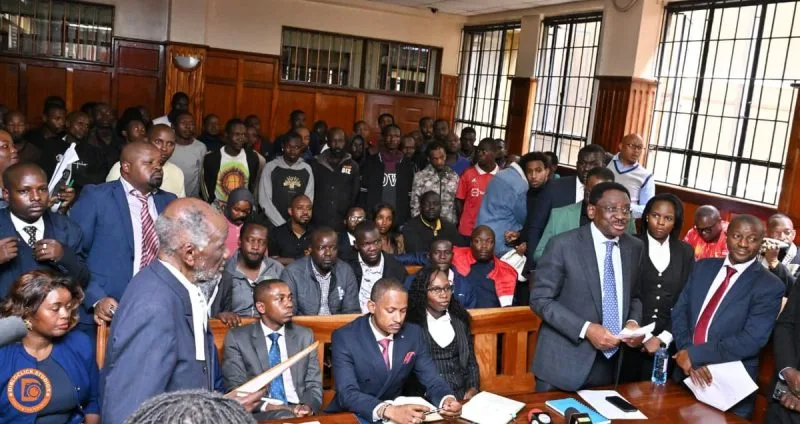
Over 200 young people arrested during recent nationwide Gen Z protests in Kenya have been released on a cash bail of Sh1,000 each. This development highlights the ongoing tension between the constitutional rights to assembly and expression, and the state's efforts to maintain public order. The court's decision to grant relatively low bail terms for such a large group of arrestees underscores the judiciary's role in safeguarding fundamental freedoms, particularly the right to bail enshrined in Article 49 of the Constitution. Legal professionals are closely watching these cases, as they set precedents for the handling of future protests and the interpretation of public order legislation in Kenya.
Introduction
Kenya recently witnessed widespread protests, primarily driven by 'Gen Z' youth, expressing dissent on various national issues. These demonstrations led to numerous arrests across the country, with a significant number of participants being taken into custody. In a notable legal development, over 200 young people apprehended during these nationwide protests were subsequently released on a cash bail of Sh1,000 each.
This mass release on relatively low bail terms has drawn considerable attention from legal practitioners and human rights advocates. It brings to the forefront critical questions regarding the balance between the constitutional right to peaceful assembly and the state's power to enforce public order. The judiciary's approach in these cases will significantly influence the landscape of civic space and the exercise of fundamental freedoms in Kenya, necessitating a thorough examination of the underlying legal frameworks and their application.
This article will delve into the legal context surrounding these arrests and the subsequent bail grants, analyzing the interplay of constitutional provisions, statutory instruments, and judicial precedents. It aims to provide practising attorneys with a comprehensive understanding of the legal implications, potential challenges, and future considerations arising from the state's response to the Gen Z protests.
Background
The right to peaceful assembly, demonstration, picketing, and presenting petitions to public authorities is a fundamental freedom enshrined in Article 37 of the Constitution of Kenya, 2010. This right, however, is not absolute and is subject to limitations that are reasonable and justifiable in a democratic society, as outlined in Article 24 of the Constitution. Complementing these constitutional guarantees, the Public Order Act (Cap 56) provides the statutory framework for regulating public gatherings. It mandates that organisers of public assemblies notify the police between three and fourteen days in advance, and a public assembly held in violation of these provisions is deemed unlawful.
Under the Penal Code (Cap 63), participation in an unlawful assembly is a misdemeanour, punishable by imprisonment for up to one year. The National Police Service Act (No. 11A of 2011) governs the powers of arrest and detention by police officers, requiring them to present an arrested person in court within twenty-four hours. Central to the current situation is Article 49(1)(h) of the Constitution, which grants an arrested person the right to be released on bond or bail on reasonable conditions, pending a charge or trial, unless there are compelling reasons not to be released. The Criminal Procedure Code (Cap 75) further elaborates on bail provisions, stipulating that the amount of bail should be fixed with due regard to the circumstances of the case and should not be excessive.
Analysis
The release of over 200 Gen Z protestors on Sh1,000 cash bail each represents a significant judicial affirmation of the right to bail in Kenya. While the Public Order Act and the Penal Code provide grounds for arresting individuals participating in assemblies deemed unlawful, the Constitution prioritises the liberty of an arrested person. Article 49(1)(h) establishes bail as a constitutional right, not a privilege, which can only be denied if compelling reasons exist. Such reasons typically include a likelihood of the accused absconding, interfering with witnesses, or committing further offences.
The Sh1,000 cash bail, particularly in the context of mass arrests, appears to be a deliberate judicial measure to ensure access to justice and prevent punitive pre-trial detention. This aligns with judicial pronouncements, such as in *Republic v Chief Magistrate's Court at Milimani & Another ex parte Kobia [2010]*, where the High Court affirmed that bail is a constitutional right and should not be refused merely to keep someone in custody. Similarly, the *Bail and Bond Policy Guidelines, 2015* emphasize that bail terms should be reasonable and not excessive, reflecting the accused's financial capacity and the nature of the alleged offence. The court's decision to reduce bail from higher initial amounts in similar protest-related cases, such as the instance where Busia Senator Okiyah Omtatah and others had their bail reduced from Sh50,000 to Sh1,000, further reinforces this principle.
However, the arrests themselves often raise questions about the interpretation and application of the Public Order Act. Critics argue that the Act, a colonial-era statute, is frequently used to suppress legitimate dissent rather than merely maintain order, and its notification requirements are sometimes treated as a prerequisite for permission rather than mere coordination. The charges levelled against protestors, which can range from unlawful assembly and incitement to violence to more severe offences like terrorism or robbery with violence, have been criticised as a 'weaponisation of the criminal justice system' to deter participation in protests. The courts, in cases like *Coalition for Reform and Democracy (CORD) v. Inspector General of Police*, have affirmed the right to peaceful assembly and the police's duty to facilitate, rather than suppress, such gatherings, interpreting the Public Order Act in line with constitutional rights.
The prompt release on bail, therefore, serves as a crucial check on potential abuses of power, ensuring that individuals are not arbitrarily detained. It also highlights the judiciary's independence in upholding constitutional rights even in politically charged environments. The involvement of prominent legal figures, such as Governor James Orengo, in representing the accused further underscores the legal community's commitment to defending these rights.
Conclusion
The release of over 200 Gen Z protestors on Sh1,000 cash bail each is a critical moment for the rule of law in Kenya, affirming the judiciary's commitment to constitutional safeguards, particularly the right to bail. For legal practitioners, this development reinforces the importance of robust advocacy for arrested persons, ensuring that bail terms are reasonable and that the constitutional presumption of innocence and the right to liberty are upheld. It also highlights the need to challenge charges that may be disproportionate or intended to stifle legitimate protest.
Practitioners should remain vigilant against the 'weaponisation of the law,' where serious charges are used to intimidate protestors. The ongoing discourse around the Public Order Act and its potential amendments suggests that the legal battle for civic space is far from over. Attorneys representing protestors must continue to leverage constitutional provisions and judicial precedents to protect fundamental freedoms. Watching how the substantive charges against these youths proceed, and whether the state pursues further legislative changes to public order laws, will be crucial in understanding the evolving landscape of protest rights in Kenya.
Citations
- 1.Constitution of Kenya, 2010
- 2.Public Order Act (Cap 56)
- 3.Penal Code (Cap 63)
- 4.Criminal Procedure Code (Cap 75)
- 5.National Police Service Act (No. 11A of 2011)
- 6.Bail and Bond Policy Guidelines, 2015
- 7.Republic v Chief Magistrate's Court at Milimani & Another ex parte Kobia [2010] eKLR
- 8.Coalition for Reform and Democracy (CORD) v. Inspector General of Police [2014] eKLR
- 9.Okiya Omtatah, 22 other protesters released as court lowers bail to Ksh.1K from Ksh.50K. (December 31, 2024). The Star.
- 10.Governor Orengo lauds court ruling freeing over 200 Gen Z protest suspects on bail. (June 26, 2026). The Eastleigh Voice.
How does this affect your business?
Get an AI analysis of this article grounded in your jurisdictions, practice areas, and any policy documents you've uploaded to Wansom.