
Namibia, China sign nine cooperation agreements
Abstract
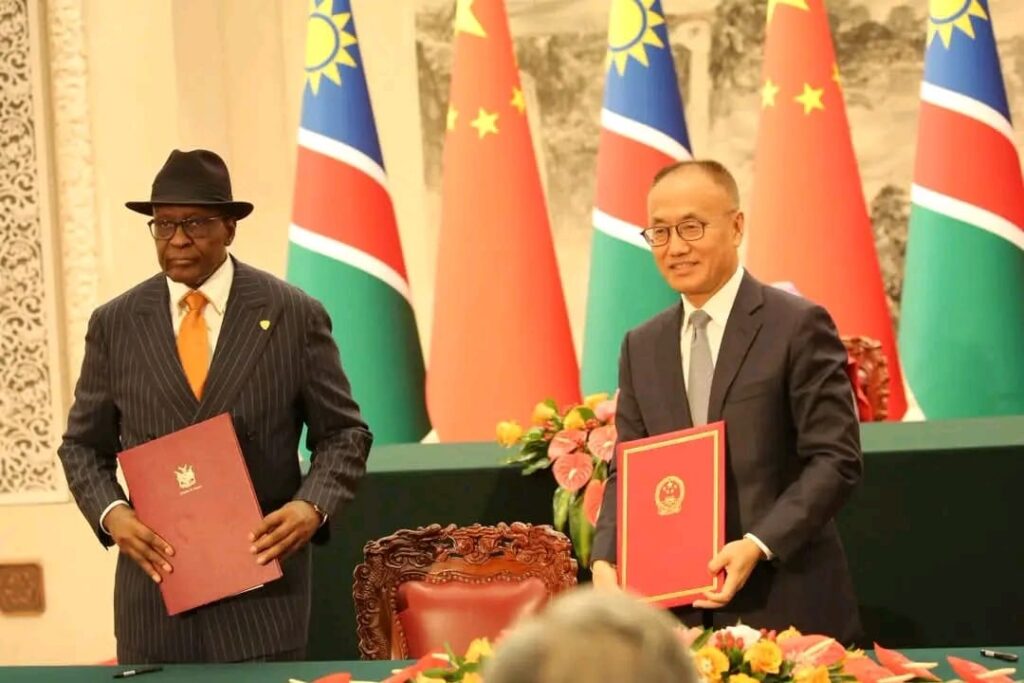
Namibia and China have recently signed a suite of cooperation agreements, encompassing nine distinct areas including economic development, health, education, mining, agriculture, tourism, media, and technology. These agreements, concluded during President Netumbo Nandi-Ndaitwah’s state visit to China from 6 to 11 July, are poised to significantly deepen bilateral ties and stimulate foreign direct investment into Namibia. For legal practitioners, these developments necessitate a thorough understanding of the interplay between international agreements and domestic law, particularly concerning investment protection, public procurement, and sector-specific regulations in Namibia, as the full legal effect of these accords will depend on their ratification and subsequent implementation.
Introduction
The recent state visit by Namibian President Netumbo Nandi-Ndaitwah to China, culminating in the signing of nine cooperation agreements, marks a pivotal moment in the bilateral relations between the two nations. These agreements, spanning critical sectors such as economic development, health, education, mining, agriculture, tourism, media, and technology, signal a concerted effort to bolster Namibia's economic growth and diversification through enhanced Chinese investment and technical support. The Presidency's confirmation of these accords underscores their strategic importance for Namibia's national development agenda.
This deepening partnership carries substantial legal implications for both public and private sector stakeholders. For Namibia, the agreements present opportunities for infrastructure development, skills transfer, and resource monetisation, while for China, they secure access to strategic resources and expand its influence in Southern Africa. However, the practical implementation and enforceability of these agreements will be contingent upon their legal classification, ratification processes, and alignment with existing domestic legal frameworks in both jurisdictions.
This article will delve into the legal context surrounding these cooperation agreements, examining the relevant statutory and doctrinal frameworks in Namibia and China. It will further analyse the potential impact on key sectors, highlighting areas of legal complexity and offering insights into the implications for legal practitioners advising clients on navigating this evolving landscape.
Background
The legal framework governing international agreements in Namibia is primarily enshrined in Article 144 of the Namibian Constitution, which stipulates that the general rules of public international law and international agreements binding upon Namibia form part of the law of Namibia, unless otherwise provided by the Constitution or an Act of Parliament. This constitutional provision establishes a monist system, meaning that once an international agreement is ratified, it is directly applicable in domestic law, although practical implementation often requires complementary domestic legislation. The President of Namibia holds the power to negotiate and sign international agreements, but for such an agreement to become binding on Namibia, it requires the agreement of the National Assembly.
Namibia has historically sought to attract foreign investment, with the Foreign Investment Act 27 of 1990 (FIA) serving as the primary legislation in this regard. The FIA guarantees equal treatment for foreign and Namibian investors, fair compensation in the event of expropriation, and the right to remit profits. It also allows for international arbitration of disputes for investors holding a Certificate of Status Investment (CSI) that includes such a provision. While Namibia is a member of the Multilateral Investment Guarantee Agency (MIGA) and has signed the International Centre for Settlement of Investment Disputes (ICSID) Convention, it has not yet ratified the latter. Notably, existing bilateral investment treaties (BITs) between Namibia and China are reported to be pending ratification, a crucial detail for investment protection.
On the Chinese side, the approach to international law is often described as “functionalist,” heavily influenced by historical experiences with “unequal treaties” and a strong emphasis on national sovereignty. While China has ratified numerous international agreements, its Law on Foreign Relations, enacted in July 2023, stipulates that treaties and agreements must not contravene the Chinese Constitution, and their implementation should not undermine national security or public interests. China typically prefers bilateral negotiation for dispute settlement over international arbitration in many contexts, although exceptions exist for trade and investment agreements, such as those under the WTO. China's bilateral investment treaties and free trade agreements, while numerous, are often perceived to offer fewer protections to foreign investors compared to those of Western nations.
Analysis
The nine cooperation agreements signed between Namibia and China, while broad in scope, require careful legal scrutiny to ascertain their precise nature and enforceability. Reports indicate that some of these agreements include a Memorandum of Understanding (MoU) on green minerals and a framework agreement on economic partnership. Generally, MOUs and framework agreements are not immediately self-executing treaties but rather express an intention to cooperate, often necessitating further specific agreements or domestic legislative action for full legal effect. The critical point for Namibian law is that, despite being signed, these agreements are likely subject to the ratification process by the National Assembly as per Article 144 of the Constitution before they become fully binding domestic law.
In the mining sector, a key area of cooperation, Namibia’s Minerals (Prospecting and Mining) Act 33 of 1992, as amended, vests all mineral rights in the State. Any foreign investment in green minerals, uranium, lithium, and rare earths will be subject to this Act, requiring specific licenses and potentially conditions imposed by the Minister of Mines and Energy, such as local ownership or community development obligations. The state-owned Epangelo Mining Proprietary Limited holds exclusive rights to certain strategic minerals, including uranium, which may necessitate joint ventures or specific arrangements with this entity. The Foreign Investment Act 27 of 1990 will govern the broader investment aspects, offering protections like fair compensation and profit repatriation, but also allowing for government-imposed restrictions.
Cooperation in infrastructure development will primarily engage Namibia's Public Procurement Act 15 of 2015, which has seen significant amendments through the Public Procurement Amendment Act 3 of 2022, with further proposed amendments in March 2025 aimed at enhancing dispute resolution and efficiency, including the establishment of a Public Procurement Court. Chinese companies seeking to participate in Namibian infrastructure projects will need to navigate these procurement regulations, which include provisions for preferences to local entities and small and medium enterprises. The emphasis on technology transfer and skills development, as highlighted in the agreements, will likely translate into specific contractual clauses within project agreements, potentially impacting labour laws and intellectual property rights.
A significant legal consideration is the status of investment protection. While Namibia's Foreign Investment Act provides certain guarantees, the absence of a ratified bilateral investment treaty (BIT) with China, as noted by some sources, means that Chinese investors might not benefit from the enhanced protections typically afforded by such treaties. This gap could lead to reliance on the less comprehensive provisions of the FIA or the specific terms embedded within the cooperation agreements themselves, which, from a Chinese perspective, tend to offer fewer investor protections than those with Western nations. The discrepancy in reporting the number of agreements (eight versus nine) also suggests that the exact legal instruments and their specific content need to be carefully verified by practitioners.
Furthermore, the agreements on phytosanitary requirements for agricultural exports, such as table grapes, will necessitate adherence to both Namibian export regulations and Chinese import standards. This involves a complex web of technical regulations and certifications, requiring meticulous compliance to facilitate trade effectively. The broader implications for economic development, health, education, tourism, media, and technology will similarly unfold through specific implementing projects and programmes, each subject to its own regulatory and contractual frameworks.
Conclusion
The recent signing of cooperation agreements between Namibia and China heralds a new phase of bilateral engagement with profound legal and economic implications. For legal practitioners, the immediate priority lies in understanding the precise legal nature of each agreement – whether they are binding treaties, framework agreements, or memoranda of understanding – and their current status within Namibia’s domestic legal system, particularly regarding ratification by the National Assembly. The absence of a ratified bilateral investment treaty with China, as indicated by some reports, means that investment protection for Chinese entities will largely depend on the provisions of the Foreign Investment Act and the specific terms negotiated within these new cooperation instruments.
Practitioners advising clients on investments or projects stemming from these agreements must conduct thorough due diligence, paying close attention to sector-specific legislation such as the Minerals (Prospecting and Mining) Act, the Public Procurement Act, and environmental regulations. Issues such as local content requirements, technology transfer clauses, dispute resolution mechanisms, and compliance with evolving labour laws will be paramount. Lawyers should also monitor the development of the proposed Public Procurement Court and any new implementing legislation that may arise from these agreements.
The coming months will be crucial for observing how these high-level cooperation agreements translate into actionable legal frameworks and commercial realities. Legal professionals are advised to stay abreast of legislative developments, engage with relevant government ministries, and prepare to counsel clients on navigating the opportunities and challenges presented by this strengthened Namibia-China partnership, ensuring compliance and safeguarding interests in a rapidly evolving legal and economic landscape.
Citations
- 1.Foreign Investment Act 27 of 1990 (Namibia)
- 2.Minerals (Prospecting and Mining) Act 33 of 1992 (Namibia)
- 3.Minerals (Prospecting and Mining) Amendment Act 8 of 2008 (Namibia)
- 4.Public Procurement Act 15 of 2015 (Namibia)
- 5.Public Procurement Amendment Act 3 of 2022 (Namibia)
- 6.Environmental Management Act 7 of 2007 (Namibia)
- 7.Labour Act 11 of 2007 (Namibia)
- 8.Constitution of the Republic of Namibia, Article 144
- 9.Law on Foreign Relations of the People's Republic of China (July 2023)
- 10.Reuters, "Namibia secures China deals on infrastructure, mining and energy with state visit" (July 10, 2026)
- 11.nbc, "NAMIBIA, CHINA SIGN COOPERATION AGREEMENTS" (YouTube, July 10, 2026)
- 12.The Official Blog of Amb. David H. Shinn, "Namibia Signs 8 Cooperation Agreements with China" (July 11, 2026)
- 13.IndexBox, "China Secures Early Position in Namibia's Emerging Oil Sector" (July 11, 2026)
- 14.U.S. Department of State, "Namibia - 2011 Investment Climate Statement"
- 15.DLA Piper, "Namibia"
- 16.Embassy of Namibia, "Legal & Policy Framwork"
- 17.Mayer Brown, "Namibia"
- 18.Legal Assistance Centre, "International Law and Human Rights - Namibia" (June 21, 2018)
- 19.Legal Assistance Centre, "What is international law and why does it matter to Namibia?" (2018)
- 20.Legal Assistance Centre, "NAMLEX APPENDIX BACKGROUND INFORMATION" (November 28, 2017)
- 21.Oxford Public International Law, "Namibia" (April 15, 2009)
- 22.African Mining Legislation Atlas, "Namibia" (April 03, 2024)
- 23.ICLG, "Mining Laws and Regulations Report 2026 Namibia" (September 16, 2025)
- 24.European Parliament, "China's compliance with selected fields of international law" (October 2020)
- 25.Brookings Institution, "International law with Chinese characteristics: Beijing and the “rules-based” global order" (October 12, 2020)
- 26.U.S. Department of Commerce, International Trade Administration, "China - Trade Agreements" (September 25, 2025)
- 27.Wikisource, "Vienna Convention on the Law of Treaties between States and International Organizations or Between International Organizations (1986)" (September 01, 2018)
- 28.UNTC, "Vienna Convention on the Law of Treaties between States and International Organizations or between International Organizations. Vienna, 21 March 1986"
- 29.Legal Assistance Centre, "International Law" (February 19, 2023)
- 30.The status of international law in Namibian national law: A critical appraisal of the constitutional strategy (January 15, 2010)
- 31.Pulse of Africa, "Namibia, China Elevate Relations, Expanding Cooperation for Africa's Development" (July 11, 2026)
How does this affect your business?
Get an AI analysis of this article grounded in your jurisdictions, practice areas, and any policy documents you've uploaded to Wansom.