
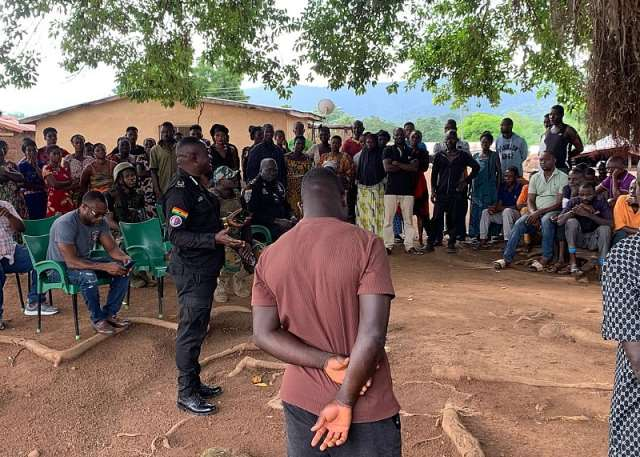
Nkwanta police investigate murder of 36-year-old man at Keri
Abstract
The Nkwanta District Police Command has initiated a murder investigation following the fatal shooting of a 36-year-old man, Thomas Adon, in Keri. This incident highlights the critical role of law enforcement in Ghana in upholding public order and ensuring justice. The investigation will proceed under the framework of Ghana's Criminal Offences Act, 1960 (Act 29) and the Criminal and Other Offences (Procedure) Act, 1960 (Act 30), focusing on evidence collection, suspect identification, and eventual prosecution. Legal professionals will closely monitor the adherence to due process and the effectiveness of the investigative procedures, given the constitutional mandate of the Attorney-General in all criminal prosecutions.
Introduction
The serene community of Keri in the Nkwanta South Municipality has been rocked by the tragic murder of Thomas Adon, a 36-year-old man, who was reportedly shot dead on a Sunday. In response, the Nkwanta District Police Command has swiftly launched a comprehensive investigation into the incident. This development underscores the persistent challenges of violent crime in certain parts of Ghana and the imperative for robust law enforcement responses to maintain peace and security. The swift initiation of an investigation is a crucial first step in the criminal justice process, aiming to bring the perpetrators to book and provide solace to the affected community.
Background
The legal framework governing criminal offences in Ghana is primarily enshrined in the Criminal Offences Act, 1960 (Act 29), which defines various crimes, including murder, and their corresponding punishments. Section 46 of Act 29 stipulates that a person who commits murder is liable to suffer death, while Section 47 defines murder as intentionally causing the death of another person by any unlawful harm, unless reduced to manslaughter by extreme provocation or other partial excuse. The procedural aspects of criminal investigations and prosecutions are governed by the Criminal and Other Offences (Procedure) Act, 1960 (Act 30). This Act outlines the powers of the police in arresting offenders, conducting searches, and gathering evidence. The Ghana Police Service, established under the Police Service Act, 1970 (Act 350), has the statutory duty to prevent and detect crime, apprehend offenders, and maintain public order and the safety of persons and property. Their role is fundamental in the initial stages of any criminal matter, including murder investigations.
Analysis
A murder investigation in Ghana typically involves several critical stages, commencing with crime scene preservation and evidence collection. The police are mandated to prevent and detect crime, and apprehend offenders. This includes securing the scene, identifying potential witnesses, and gathering forensic evidence such as fingerprints, footprints, and DNA. The quality of the initial investigation is paramount, as it forms the foundation for any subsequent prosecution. Challenges often arise from inadequate resources, insufficient training for crime scene investigators, and a reliance on manual processes, which can hinder the effective resolution of cases.
Under the Ghanaian legal system, the burden of proof in criminal cases, particularly for murder, requires proof beyond a reasonable doubt. The prosecution must establish several key elements: that a person is dead, that the death resulted from unlawful harm, that the harm was intentionally caused, and that the accused person was the one who caused the unlawful harm. The element of intent is crucial, distinguishing murder from manslaughter, and can be inferred from the weapon used or the manner in which the harm was inflicted. The Attorney-General holds the constitutional responsibility for the initiation and conduct of all prosecutions of criminal offences in Ghana, as stipulated in Article 88(3) of the 1992 Constitution. While police officers may institute criminal proceedings in District Courts, the Attorney-General retains overarching control and oversight, including the power to appoint public prosecutors and intervene in cases.
Case law, such as *Joseph Kwasi Quarshie v. The Republic* [2018] GHASC 13, reinforces the stringent requirements for proving murder, emphasizing the need for the prosecution to demonstrate each ingredient of the offence beyond a reasonable doubt. Similarly, *The State v. Ali Kassena* [1962] 1 GLR 144 highlights the judge's duty to assess the sufficiency of evidence before a case is submitted to a jury, particularly in circumstantial evidence cases where a higher standard of proof is required. The investigation into Thomas Adon's murder will therefore require meticulous adherence to these principles, ensuring that all evidence is lawfully obtained and robust enough to withstand judicial scrutiny. Any failure in these initial stages can significantly impact the outcome of the case, potentially leading to acquittals or appeals.
Conclusion
The ongoing murder investigation by the Nkwanta District Police Command represents a critical test of Ghana's criminal justice system. For legal practitioners, this case underscores the importance of understanding the intricate interplay between investigative procedures, statutory requirements, and constitutional mandates. Defence attorneys will be keen to ensure due process is followed, scrutinizing the evidence collection methods and the establishment of intent. Prosecutors, on the other hand, will face the challenge of building a case that meets the high standard of proof beyond a reasonable doubt, as required for murder charges under Act 29. The outcome of this investigation will not only determine justice for Thomas Adon but also serve as a benchmark for the effectiveness and integrity of criminal justice administration in Ghana. Practitioners should closely monitor developments, as they may offer valuable insights into the practical application of criminal law and procedure.
Citations
- 1.Criminal Offences Act, 1960 (Act 29)
- 2.Criminal and Other Offences (Procedure) Act, 1960 (Act 30)
- 3.Police Service Act, 1970 (Act 350)
- 4.Constitution of the Republic of Ghana, 1992, Article 88(3)
- 5.Joseph Kwasi Quarshie v. The Republic [2018] GHASC 13
- 6.The State v. Ali Kassena [1962] 1 GLR 144
How does this affect your business?
Get an AI analysis of this article grounded in your jurisdictions, practice areas, and any policy documents you've uploaded to Wansom.