
Opposition unveils 'People's Budget' ahead of 202627 fiscal plan
Abstract
Kenya's political opposition has unveiled an alternative fiscal framework, dubbed the 'People's Budget,' for the Financial Year 2026-27, directly challenging the government's proposed Sh4.8 trillion expenditure plan. This alternative budget, valued at Sh4.32 trillion, aims to reduce the projected Sh1.1 trillion borrowing gap by focusing on enhanced revenue compliance and efficiency rather than new taxes. The opposition critiques the government's budget for its perceived fiscal recklessness, excessive borrowing, and the substantial allocation of Sh1.5 trillion to debt servicing and pensions, which they argue crowds out essential public services. This development highlights the critical role of parliamentary oversight and public participation in Kenya's budget-making process, underscoring the legal principles of fiscal responsibility enshrined in the Constitution and the Public Finance Management Act, 2012.
Introduction
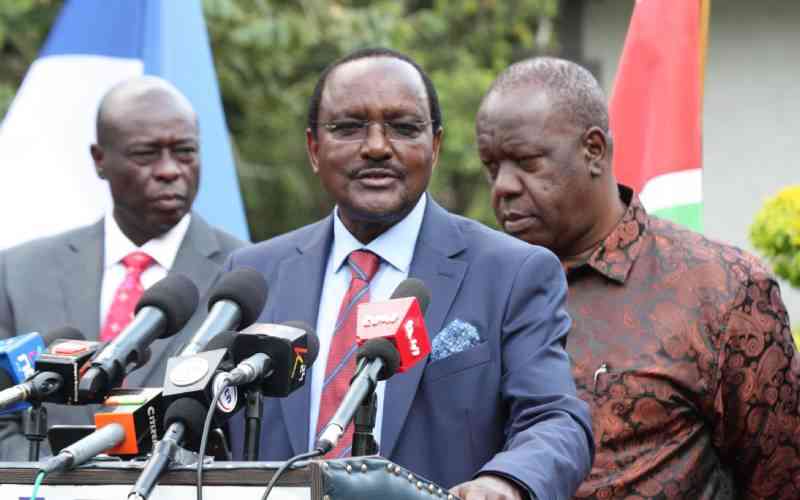
The political landscape in Kenya is currently animated by a robust debate over the nation's fiscal direction, as the opposition coalition has presented its 'People's Budget' for the Financial Year 22026-27. This alternative proposal comes ahead of the government's official Sh4.8 trillion fiscal plan, setting the stage for a significant parliamentary and public discourse on economic priorities and fiscal sustainability. The opposition, led by Wiper Party leader Kalonzo Musyoka, argues that the government's budget is characterized by excessive borrowing and misplaced priorities, projecting a substantial Sh1.1 trillion borrowing gap against a revenue estimate of Sh3.6 trillion.
This move by the opposition is not merely a political statement but a critical exercise in accountability and an assertion of the principles of public finance management. By tabling a detailed alternative, the opposition seeks to influence the legislative process and public opinion, emphasizing a more sustainable and people-centred economic model. The core of their argument revolves around the high cost of debt servicing and pensions, which they claim consumes Sh1.5 trillion, directly competing with vital public services like education and healthcare.
The unveiling of the 'People's Budget' therefore brings to the fore fundamental legal and economic questions regarding Kenya's adherence to fiscal responsibility principles, the constitutional mandate for prudent public finance management, and the efficacy of parliamentary oversight. This article will delve into the legal framework governing Kenya's budget process, analyze the implications of the opposition's proposals, and consider the broader practitioner implications for attorneys engaged in public finance and policy.
Background
The legal framework for public finance in Kenya is primarily anchored in Chapter 12 of the Constitution of Kenya, 2010, and further elaborated by the Public Finance Management Act (PFMA), 2012. Article 201 of the Constitution sets out guiding principles for all aspects of public finance, mandating openness, accountability, public participation, promotion of an equitable society, prudent and responsible use of public money, and clear fiscal reporting. These principles are designed to ensure transparency and responsible management of public resources at both national and county levels.
The PFMA, 2012, provides the extensive framework for the budget process, which typically involves four key stages: Formulation, Approval, Implementation, and Audit & Evaluation. Key documents in this cycle include the Budget Policy Statement (BPS), submitted to Parliament by February 15th, and the detailed budget estimates, submitted by April 30th. Parliament, through committees like the Budget and Appropriations Committee, plays a crucial oversight role, including facilitating public participation in the budget-making process.
Crucially, the PFMA also outlines fiscal responsibility principles, which include requirements that government borrowing should primarily finance development expenditure, not recurrent costs, and that public debt must be maintained at a sustainable level. In October 2023, Kenya transitioned from a nominal debt ceiling to a debt anchor set at 55% of the Gross Domestic Product (GDP), with a flexibility window not exceeding 5% to accommodate up to 60%. However, recent reports indicate that Kenya's public debt has surpassed this legal threshold, reaching approximately 69.9% of GDP as of March 2026, highlighting significant fiscal pressures.
Analysis
The opposition's 'People's Budget' directly challenges the government's fiscal strategy, particularly concerning the projected Sh1.1 trillion borrowing gap for FY2026-27. The government's proposed Sh4.82 trillion expenditure plan against Sh3.63 trillion in projected revenue implies a fiscal deficit that the opposition argues is unsustainable and indicative of fiscal recklessness. This deficit, if financed through continued borrowing, risks exacerbating Kenya's already high public debt, which recently stood at Sh12.82 trillion, exceeding the 55% GDP debt anchor by a significant margin.
The opposition's alternative, a Sh4.32 trillion spending plan, aims to reduce the fiscal deficit to 2.8% of GDP (approximately Sh593.5 billion) by focusing on improved tax compliance and efficiency rather than imposing new taxes. This approach aligns with the constitutional principle of promoting an equitable society where the burden of taxation is shared fairly, as stipulated in Article 201(b)(i) of the Constitution. Their proposals, such as scrapping the Affordable Housing Levy, reducing State House and National Intelligence Service expenditure, and implementing a Single Treasury Account, are presented as measures to curb wasteful spending and enhance public resource management.
The legal implications of this debate are profound. The PFMA, 2012, mandates the National Treasury to enforce fiscal responsibility principles, including ensuring that government borrowing is used for development expenditure and that public debt is sustainable. The opposition's critique that Sh1.5 trillion is allocated to debt servicing and pensions, effectively crowding out essential services, raises questions about the government's adherence to these principles and the equitable sharing of the burden and benefits of public borrowing between present and future generations, as required by Article 201(c) of the Constitution.
While the opposition's budget is not legally binding, its significance lies in its role as a critical oversight mechanism. It provides a detailed counter-narrative, forcing greater scrutiny of the government's budget estimates and the Finance Bill 2026 during parliamentary debate. This engagement is crucial for fulfilling the constitutional requirement of public participation in financial matters and ensuring accountability. The government, through the Treasury Cabinet Secretary, has maintained that its budget was developed through extensive public consultations and complies with the constitutional and statutory requirements. However, the stark differences in fiscal projections and priorities between the government and the opposition highlight potential gaps in interpretation or application of these legal principles, particularly concerning fiscal discipline and debt sustainability. The ongoing debate also touches on the use of Article 223 of the Constitution for supplementary expenditures, which has seen a significant increase, raising concerns about adherence to approved budget provisions.
Conclusion
The unveiling of the 'People's Budget' by Kenya's opposition marks a significant moment in the country's public finance discourse, underscoring the intricate interplay between legal frameworks, economic realities, and political accountability. For legal practitioners, this development highlights the increasing importance of understanding the Public Finance Management Act, 2012, and Chapter 12 of the Constitution, 2010, particularly concerning fiscal responsibility principles, public debt management, and the budget approval process. The opposition's detailed critique and alternative proposals serve as a powerful reminder of the legal and ethical obligations of government in managing public resources prudently and transparently.
Practitioners advising government entities, private sector clients, or civil society organizations must closely monitor the ongoing parliamentary debates on the FY2026-27 budget and the Finance Bill 2026. The outcome of these discussions will not only shape Kenya's economic trajectory but also set precedents for the enforcement of fiscal discipline and the role of opposition in democratic governance. Attorneys should be prepared to navigate potential shifts in tax policy, public spending priorities, and regulatory frameworks that may arise from this heightened scrutiny, ensuring compliance and advocating for sound financial governance in line with constitutional mandates.
Citations
- 1.Constitution of Kenya, 2010
- 2.Public Finance Management Act, 2012 (No. 18 of 2012)
- 3.Kenya's FY 2026/27 Budget: Winners, Losers, and What the Sector Allocations Mean for Citizens - Institute of Public Finance (June 11 2026)
- 4.Kenya 2026/27 Budget Brief - KPMG agentic corporate services (June 11 2026)
- 5.legislative framework for the national and county budget processes in kenya.1 - University of Nairobi, Women's Economic Empowerment Hub
- 6.ICPAK 07-A/2014 POSITION PAPER ON PARAMETERS FOR MEASURING FISCAL DISCIPLINE IN KENYA
- 7.No. 30/2023-2024 Public Debt Ceiling: The Experience for Kenya and Lessons from Other Countries
- 8.Ninety Fourth Sovereign Debt News Update: Kenya breaches its Debt Ceiling, anchors its Debt to GDP | Afronomicslaw (September 04 2023)
- 9.The state of Kenya's public debt: - International Budget Partnership
- 10.Explainer: The Kenya budget cycle - People Daily (February 28 2026)
- 11.Opposition unveils 'People's Budget' ahead of 202627 fiscal plan - Standard Newspaper (June 10 2026)
- 12.Report On Budget Estimates For Fy 2026/27 - Parliament of Kenya (June 02 2026)
- 13.Public Finance under Kenya's new Constitution - ConstitutionNet
- 14.Budget Brief - Drafting Regulations for Kenya's Public Financial
- 15.The Constitution Of Kenya: Chapter 12 - Public Finance (Article 201-231) - Text & Audio (August 10 2023)
- 16.Kenya: Public Debt Hits Sh12.82 Trillion, Exceeds GDP Threshold By 15 Percentage Points (June 10 2026)
- 17.How Kenya's Budget Cycle Works | From Planning to Public Participation - YouTube (May 18 2026)
- 18.Kenya 2010 - Constitute Project
- 19.Kenya's debt hits 67% of GDP, surpassing legal limit - YouTube (November 14 2025)
- 20.Why Kenya Needs Budget Writing Rules: A Law and Economics Approach (March 13 2026)
- 21.Opposition Unveils 'People's Budget', Accuses Ruto Govt of Economic Mismanagement (June 11 2026)
- 22.Ruto under pressure as opposition unveils alternative budget to ease taxes - People Daily (June 11 2026)
- 23.Kalonzo Rallies Western Kenya Behind Opposition Agenda, Attacks Government Budget (June 12 2026)
- 24.Opposition unveils 'People's Budget', tears into Ruto's Ksh.4.8 trillion spending plan (June 10 2026)
- 25.Kalonzo Vows To Scrap Ruto's Ksh104 Billion Legacy Project - The Kenya Times (June 11 2026)
How does this affect your business?
Get an AI analysis of this article grounded in your jurisdictions, practice areas, and any policy documents you've uploaded to Wansom.