
Ruto Assents to CBK Emergency Liquidity Amendment and Parliamentary Pensions Reform, Strengthening Financial Stability Framework and Updating Pension Governance
Abstract
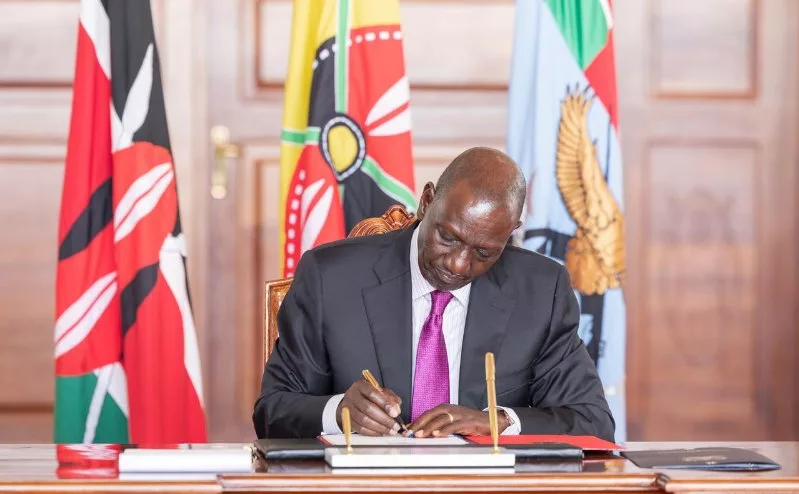
Two statutes have received presidential assent. The CBK amendment preserves the central bank's discretion to determine which financial institutions qualify for emergency liquidity support, the applicable interest rates, and the duration of assistance, which may run for up to 12 months extendable to five years based on recovery prospects. The amendment also expands the CBK School of Monetary Studies to operate regionally and generate revenue. The Parliamentary Pensions Amendment Act updates the 1983 framework to recognise dependants up to age 18 consistent with the Constitution, include the Senate alongside the National Assembly in pension governance structures, and extend beneficiary recognition to widowers of deceased female MPs. For financial institutions and microfinance operators, the CBK amendment confirms the legislative basis for structured emergency liquidity support and the CBK's broad discretion in its application. For parliamentary pension administrators and HR professionals, the pensions amendment resolves longstanding inconsistencies between the 1983 Act and current constitutional standards.
Introduction
The CBK amendment addresses a specific gap in the emergency liquidity framework. Central banks providing lender-of-last-resort support need clear legal authority for the terms on which that support is extended, including the CBK's ability to set interest rates and durations without legislative prescription for each intervention. The amendment confirms that discretion and extends the maximum duration of distress liquidity assistance from what appears to have been a shorter statutory window to a five-year ceiling in cases where a receiving institution's recovery warrants continued support. The practical beneficiaries are likely to be microfinance institutions, which the legislation specifically references, given their comparatively weaker capital buffers and greater vulnerability to liquidity stress.
The Parliamentary Pensions Amendment is a governance correction rather than a substantive policy change. The 1983 Act was enacted under a unicameral legislature and before Kenya's current constitutional definition of adulthood, and its failure to recognise widowers despite administrative practice having evolved in that direction was an unresolved legal inconsistency. The amendment formalises what practice had already established and brings the framework into alignment with Articles 27 and 93 of the Constitution.
Background
The Central Bank of Kenya Act, Cap 491, is the primary statute governing the CBK's mandate, powers, and operations. The lender-of-last-resort function, providing emergency liquidity to financial institutions facing temporary distress, is a core central banking tool used to prevent isolated institutional difficulties from becoming systemic crises. The amendment preserves the CBK's discretion rather than prescribing fixed terms, which is the approach recommended by the IMF and World Bank in central banking governance standards. The extension of the School of Monetary Studies' mandate to regional operations and revenue generation is a secondary but commercially significant change, allowing the CBK to position the school as a regional financial training institution with an independent revenue base.
The Parliamentary Pensions Act, No. 7 of 1983, has governed pensions for members of Parliament since before Kenya's constitutional reforms. The Constitution of Kenya 2010 established a bicameral Parliament with the Senate alongside the National Assembly, redefined the age of majority as 18, and entrenched gender equality as a constitutional principle under Article 27. The amendment brings the 1983 Act into conformity with these constitutional requirements, which should have been addressed in the broader post-2010 statute law revision process but was not completed until now.
Analysis
The CBK amendment's most consequential element is the five-year maximum duration for distress liquidity assistance. A 12-month initial window extendable to five years gives the CBK a structured medium-term intervention tool that goes beyond the conventional lender-of-last-resort model, which typically provides short-term bridge liquidity rather than multi-year support. This is a meaningful departure from standard central banking practice and reflects Kenya's microfinance sector's specific characteristics: institutions in this category often carry structural weaknesses that cannot be resolved within a 12-month window but that do not warrant outright resolution or closure if their social impact and recovery prospects are credible. For the CBK, this extended authority comes with a corresponding responsibility to establish clear criteria for what recovery prospects justify extension beyond 12 months, to prevent the provision from becoming a mechanism for indefinite support of institutions that should be resolved.
For microfinance institutions, the amendment confirms the legislative basis for structured support that may not have been unambiguously available under the prior framework. Institutions facing liquidity stress should understand that accessing this support requires CBK discretionary approval, that the CBK retains full control over terms, and that the support does not prevent the CBK from taking supervisory action if underlying solvency concerns exist. Liquidity support and solvency support are legally and operationally distinct, and an MFI that mistakes one for the other in its dealings with the CBK faces a governance and compliance risk. Legal counsel advising microfinance boards should ensure that boards understand this distinction before any application for distress support is made.
The Parliamentary Pensions amendments, while narrower in scope, have a direct implication for pension administrators: the governance structures of pension committees and tribunals under the Act must now be updated to include Senate representation. Any committee or tribunal that has been operating without Senate representation since the 2010 Constitution took effect has arguably been constituted in a manner inconsistent with the current bicameral framework, and the amendment formalises what the constitutional structure required. Administrators should confirm composition of all relevant bodies and update them accordingly without delay now that the legal basis for Senate inclusion is explicit.
Conclusion
Both laws address real gaps. The CBK amendment gives the central bank a clearer and more flexible emergency liquidity tool with a medium-term duration that reflects the microfinance sector's specific needs. The Parliamentary Pensions amendment resolves longstanding inconsistencies that should have been corrected earlier in the post-2010 reform cycle. For MFIs, the amendment is the more immediately consequential development and requires board-level clarity on how the new framework applies in practice. For pension administrators, the governance update is the priority action.
Citations
- 1.Central Bank of Kenya Act, Cap 491, Laws of Kenya (as amended 2026)
- 2.Parliamentary Pensions Act, No. 7 of 1983 (as amended by the Parliamentary Pensions Amendment Act, 2026)
- 3.Constitution of Kenya, 2010, Articles 27 (equality), 93 (Parliament), and 260 (age of majority)
- 4.Presidential assent ceremony, State House Nairobi, 6 July 2026