
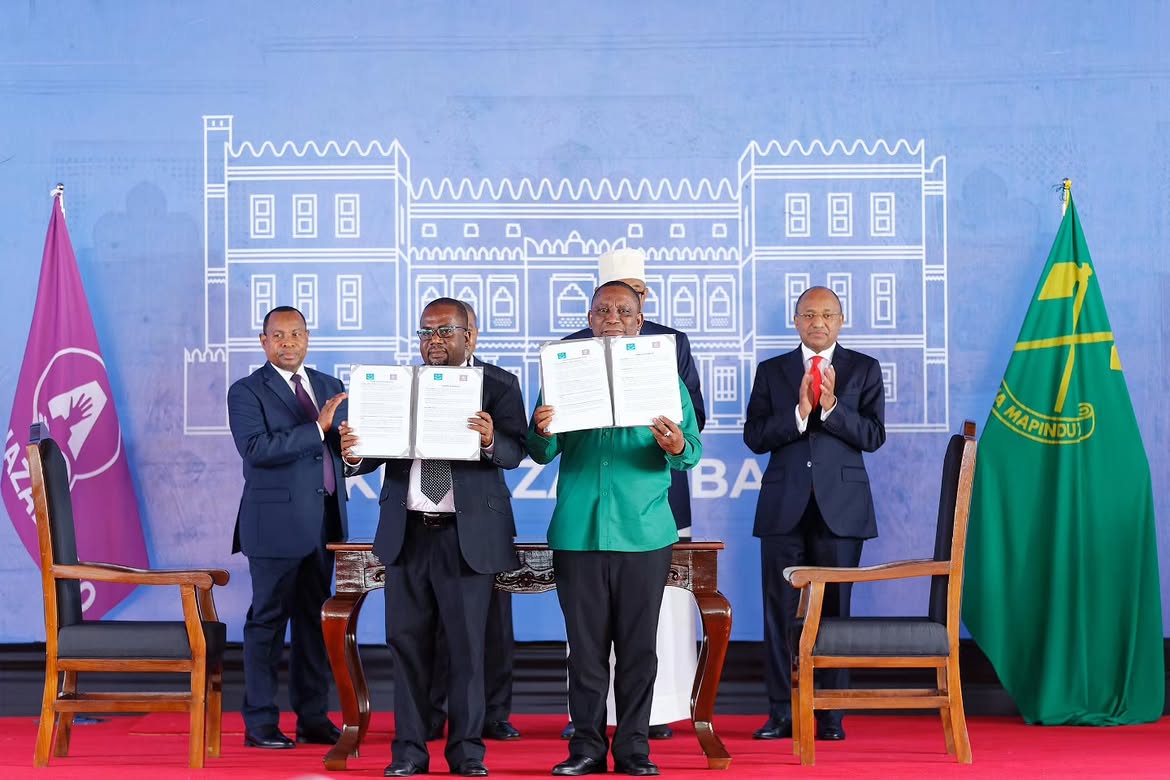
Scores welcome GNU accord
Abstract
Zanzibar has recently witnessed a significant political development with the signing of a joint reconciliation accord between the ruling Chama Cha Mapinduzi (CCM) and the opposition ACT Wazalendo. This agreement, following the contentious 2025 general elections, aims to establish a framework for comprehensive institutional reforms, including constitutional review, electoral system enhancements, and judicial depoliticisation. Building on the constitutional provisions for a Government of National Unity (GNU) first institutionalized in 2010, the accord seeks to foster national unity, reconciliation, and sustainable peace, thereby addressing decades of political divisions and electoral disputes. Legal professionals should note the commitment to strengthening democratic governance, accountability, and the rule of law, which is anticipated to create a more stable and predictable legal and business environment in the semi-autonomous archipelago.
Introduction
Zanzibar's political landscape has long been characterised by recurring electoral disputes and periods of tension, often stemming from closely contested polls since the reintroduction of multiparty politics in 1992. The recent signing of a joint reconciliation accord between the dominant Chama Cha Mapinduzi (CCM) and the main opposition party, ACT Wazalendo, on July 9, 2026, marks a pivotal moment in the Isles' ongoing quest for political stability and national cohesion. This agreement, a direct response to the concerns arising from the 2025 General Election, has been widely welcomed by citizens and political leaders alike, who view it as a crucial step towards strengthening unity, preserving peace, and accelerating development in the semi-autonomous region.
The accord is not merely a political truce but a comprehensive commitment to institutional reforms, aiming to address the root causes of past conflicts. It outlines an ambitious agenda encompassing constitutional review, electoral reform, judicial and legal reform, and enhanced public service accountability. The agreement's central thesis is to solidify the framework for a Government of National Unity (GNU), a concept previously enshrined in the Zanzibar Constitution, to ensure inclusive governance and mitigate the winner-takes-all political system that has historically fuelled divisions. For legal practitioners, this development signals a renewed focus on the rule of law, institutional strengthening, and potentially a more predictable regulatory environment, which could significantly impact investment and socio-economic development.
Background
The political history of Zanzibar since the advent of multiparty democracy in 1992 has been marred by a series of contentious elections, notably in 1995, 2000, 2005, and 2015, each often followed by allegations of irregularities and political impasses. These recurrent disputes underscored the urgent need for a more durable political settlement. A significant milestone in this regard was the 'Maridhiano' (reconciliation) process initiated in 2009, which led to a historic referendum on July 31, 2010. Zanzibaris overwhelmingly approved the formation of a Government of National Unity (GNU), with 68.7 percent voting in favour.
This popular mandate led to constitutional amendments in August 2010, integrating the GNU framework into the Zanzibar Constitution of 1984. Specifically, Articles 9(3) and 39 of the Constitution of Zanzibar, 1984, as amended, provide the legal basis for the GNU, stipulating that the President must appoint the First Vice President from the party that comes second in the presidential election, provided it secures a certain threshold of votes, and allocate ministerial positions proportionally. The GNU, comprising the winning party (historically CCM) and the leading opposition (previously the Civic United Front, CUF), was intended to foster power-sharing and reduce political polarisation. While the 2010-2015 GNU brought a period of relative calm, its collapse following the annulment of the 2015 elections highlighted inherent structural challenges and the need for more robust mechanisms to ensure its sustainability and genuine power-sharing.
Analysis
The recently signed Joint Declaration and Action Agenda between CCM and ACT Wazalendo represents a renewed effort to operationalise and strengthen the constitutional provisions for a Government of National Unity, particularly after the contentious 2025 General Election. The accord explicitly references the implementation of constitutional provisions on the GNU under Articles 9(3) and 39 of the 1984 Zanzibar Constitution, affirming its legal grounding. However, past experiences with the GNU, particularly the 2010-2015 iteration involving CCM and CUF, revealed challenges such as the dominance of the ruling party in key decision-making and a lack of clear mechanisms for implementing government policy that truly reflected a coalition.
This new accord seeks to address these gaps by committing to a comprehensive reform agenda. Key areas include a constitutional review, electoral reform aimed at improving management systems for free, fair, and credible elections, and the depoliticisation and enhancement of the impartiality and efficiency of the justice system. The agreement also calls for public service accountability and the establishment of a legal oversight body. The commitment to restructuring the Zanzibar Electoral Commission (ZEC) to guarantee "verifiable vote tabulation" and decentralising local administration, including the appointment of local officials, directly targets historical sources of electoral disputes and allegations of rigging.
From a comparative law perspective, power-sharing agreements often face the challenge of transitioning from political pacts to fully institutionalised legal frameworks that are resilient to political fluctuations. The Zanzibar GNU, being constitutionally mandated, possesses a stronger legal foundation than many other coalition governments formed purely through political agreements. However, its sustainability has historically been challenged by the high threshold of votes required for opposition participation and the dependence on general election results. The current accord's emphasis on a joint implementation committee and a statutory institution to oversee reforms suggests an attempt to create more robust, legally binding mechanisms for its long-term success, moving beyond mere political goodwill.
Furthermore, the accord’s commitment to inclusivity, involving other political parties and civil society organisations, is crucial for its legitimacy and broad public ownership. This inclusive approach, coupled with principles of truth, sincerity, integrity, and transparency, aims to rebuild political trust and ensure that Zanzibar's national interests supersede partisan considerations. The proposed judicial and legal reforms, particularly the depoliticisation of the judiciary, are vital for upholding the rule of law and ensuring that disputes are resolved impartially, which is a cornerstone of any stable democratic system.
Conclusion
The recent GNU accord in Zanzibar represents a significant legal and political undertaking, aiming to cement a lasting framework for peace, stability, and democratic governance. For legal practitioners, this development signals a potential era of enhanced institutional predictability and a renewed commitment to the rule of law. The proposed constitutional, electoral, and judicial reforms will likely lead to legislative amendments and new regulatory instruments, requiring attorneys to stay abreast of these changes, particularly those involved in electoral law, public administration, and human rights litigation.
Practitioners should closely monitor the establishment and functioning of the Joint Dialogue Committee and the proposed statutory institution tasked with overseeing the implementation of the agreed reforms. The success of this accord hinges on the genuine political will of both CCM and ACT Wazalendo to adhere to its principles and implement the reforms diligently. A stable and transparent legal environment, underpinned by fair elections and an independent judiciary, is crucial not only for political reconciliation but also for attracting foreign investment and fostering economic growth in Zanzibar. The legal community has a vital role to play in supporting these reforms, ensuring accountability, and advocating for the full realisation of the accord's objectives for a more just and prosperous Zanzibar.
Citations
- 1.The Constitution of Zanzibar, 1984 (as amended up to 2010)
- 2.Daily News Tanzania, "Scores welcome GNU accord" (July 10, 2026)
- 3.Daily News Tanzania, "What accord entails" (July 10, 2026)
- 4.Daily News Tanzania, "GNU accord ushers in hope" (July 10, 2026)
- 5.The Citizen Tanzania, "Inside CCM–ACT Wazalendo political reconciliation accord" (July 10, 2026)
- 6.The Citizen Tanzania, "Peace pact seen boosting Zanzibar's investment appeal" (July 9, 2026)
- 7.The Chanzo, "Ruling Party and Opposition Sign Major Reconciliation Deal in Zanzibar" (July 10, 2026)
- 8.Model Diplomat, "Zanzibar Accord: Tanzania's Isles Break Cycle" (July 9, 2026)
- 9.Zanzibar reconciliation deal sets stage for government of national unity (July 9, 2026)
- 10.CCM, ACT Wazalendo agree roadmap to end Zanzibar's election disputes (July 9, 2026)
- 11.Democracy versus Stability: Political Reconciliation and the Government of National Unity in Zanzibar - Kujenga Amani (August 4, 2014)
- 12.The 2010 Zanzibari government of national unity referendum - Grokipedia (October 29, 2000)
- 13.Averting Violence in Zanzibar's Knife-edge Election | International Crisis Group (June 11, 2019)
- 14.The Recurrence of Political Conflicts in Zanzibar: The Ultimate Resort to Consolidating a Democratic Culture? - University of Dodoma Journals (October 28, 2015)
- 15.Zanzibar Government of National Unity Referendum, 2010 - Ballotpedia
- 16.Beyond polarity in Zanzibar? The 'silent' referendum and the government of national unity (April 26, 2012)
- 17.THE RISE AND FALL OF THE GOVERNMENT OF NATIONAL UNITY IN ZANZIBAR - Electoral Institute For Sustainable Democracy In Africa
- 18.ZANZIBAR GOVERNMENT OF NATIONAL UNITY: A PANACEA TO POLITICAL STABILITY OR A STRATEGY TO SUSTAINABLE ECONOMIC DEVELOPMENT? | Journal of Asian and African Social Science and Humanities
- 19.ZANZIBAR GOVERNMENT OF NATIONAL UNITY: AN OBVIOUS CONSTITUTIONAL CHALLENGE FOR ITS SUSTAINABILITY - Indian Journal of Law and Legal Research (September 5, 2024)
- 20.The Political Crisis in Zanzibar - CSIS (March 18, 2016)
- 21.Zanzibar's Turbulent Transition - GSDRC
- 22."THE BULLETS WERE RAINING"
How does this affect your business?
Get an AI analysis of this article grounded in your jurisdictions, practice areas, and any policy documents you've uploaded to Wansom.