
Why Zanzibar’s political accord matters for peace, unity and prosperity
Abstract
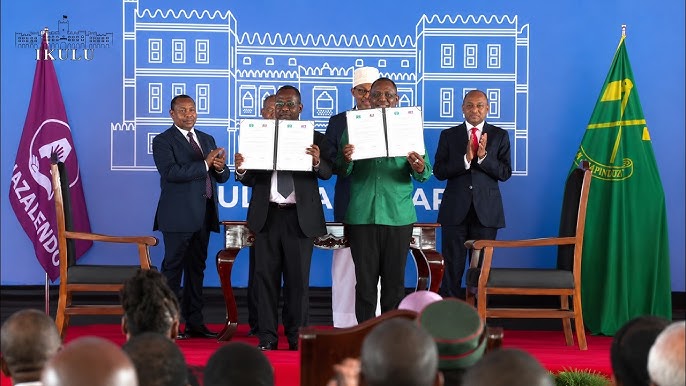
Zanzibar's recent political reconciliation agreement, signed on July 9, 2026, between the ruling Chama Cha Mapinduzi (CCM) and the opposition ACT Wazalendo, marks a pivotal moment for the semi-autonomous archipelago. Dubbed the "Joint Declaration and Action Agenda" or "Tamko la Pamoja," this accord aims to resolve the prolonged political impasse that followed the contentious October 2025 general elections. It represents a renewed commitment to dialogue, national unity, and inclusive development, reinforcing the belief that lasting peace is the strongest foundation for Zanzibar’s prosperity. The agreement outlines a comprehensive agenda for constitutional, electoral, and governance reforms, including the restructuring of the Zanzibar Electoral Commission and depoliticisation of the judiciary, seeking to institutionalise political stability and uphold the rule of law.
Introduction
The political landscape of Zanzibar has historically been characterised by periods of intense contestation and reconciliation, particularly since the re-introduction of multi-party politics in 1992. The latest chapter in this ongoing narrative unfolded on July 9, 2026, with the signing of a landmark political reconciliation agreement between Chama Cha Mapinduzi (CCM), the ruling party, and ACT Wazalendo, the main opposition. This "Joint Declaration and Action Agenda," also known as "Tamko la Pamoja," is a direct response to the political deadlock that emerged after the disputed October 2025 general elections, which saw ACT Wazalendo reject the results and initially boycott the constitutionally mandated Government of National Unity (GNU).
This accord transcends a mere cessation of hostilities; it signifies a profound commitment to fostering a culture of dialogue, national unity, and inclusive governance. President Samia Suluhu Hassan, witnessing the signing, underscored its importance as a demonstration of political maturity and patriotism, prioritising the collective interests of Zanzibar and the United Republic of Tanzania over partisan agendas. For legal practitioners, this agreement is crucial as it promises to reshape the legal and institutional frameworks governing elections, justice, and administration in Zanzibar, potentially ushering in an era of enhanced legal certainty and stability essential for economic growth and investor confidence.
This article will delve into the statutory and doctrinal underpinnings of political reconciliation in Zanzibar, analyse the key provisions of the 2026 accord, and explore its implications for the rule of law and democratic governance. It will highlight the historical context of power-sharing arrangements and assess the potential for this new agreement to deliver on its promise of lasting peace, unity, and prosperity, offering insights for legal professionals navigating Zanzibar's evolving political and legal environment.
Background
Zanzibar's journey towards political stability has been marked by a series of power-sharing arrangements aimed at mitigating post-election tensions. The concept of a Government of National Unity (GNU) was formally enshrined in the Zanzibar Constitution following a historic referendum in 2010. This constitutional amendment stipulated that the party with the second-highest number of votes in a general election would be allocated the position of First Vice President and a proportional share of cabinet portfolios, thereby moving away from a winner-takes-all system. This framework was a culmination of earlier reconciliation efforts, including Muafaka I (1999) and Muafaka II (2001), which were brokered to address persistent political feuds and electoral irregularities.
The constitutional structure of Tanzania itself provides for a unique semi-autonomous relationship between mainland Tanzania (formerly Tanganyika) and Zanzibar. The Union Constitution of 1977 (as revised in 2005) establishes a two-tier government, with the Union Government overseeing specific Union Matters and the Revolutionary Government of Zanzibar exercising authority over non-union affairs. This dual governance structure, while granting Zanzibar significant autonomy, has also been a source of complex legal and political dynamics, particularly concerning electoral processes and the balance of power. The 2025 general elections, which saw President Hussein Mwinyi re-elected amidst allegations of irregularities by ACT Wazalendo, reignited these tensions, leading to the opposition's boycott of the GNU and necessitating the recent reconciliation efforts.
The broader legal framework governing elections and political parties in Tanzania has also been a subject of ongoing reform. Recent enactments, such as the Presidential, Parliamentary, and Councillors Elections Act, 2024, the Independent National Electoral Commission Act, 2024, and the Political Parties Affairs Act, 2024, reflect a national push towards enhancing democratic practices. However, contentious issues, such as Article 41(7) of the Constitution, which precludes challenging presidential election results in court, remain critical points for further constitutional and legal reform discussions, underscoring the intricate interplay between political agreements and statutory amendments.
Analysis
The "Joint Declaration and Action Agenda" of July 9, 2026, represents a significant legal and political commitment by CCM and ACT Wazalendo to address long-standing issues of governance and electoral integrity in Zanzibar. At its core, the accord aims to strengthen democratic governance by supporting institutions that uphold accountability, good governance, and the rule of law. A central component is the commitment to ensuring free and fair elections and an independent justice system, which directly tackles the grievances that led to the post-2025 election impasse.
Crucially, the accord outlines a comprehensive reform agenda across four key pillars: constitutional overhaul, restructuring of the Zanzibar Electoral Commission (ZEC) to guarantee "verifiable vote tabulation," depoliticisation of the judiciary, and decentralisation of local administration, including the appointment of *mashehe*. The proposed constitutional overhaul signals an intent to review and potentially amend the Zanzibar Constitution beyond the existing GNU framework, which was established through the 2010 referendum. This could lead to more robust checks and balances, and a clearer delineation of powers, addressing historical criticisms of executive dominance and electoral manipulation. The commitment to restructuring the ZEC and ensuring verifiable vote tabulation is particularly vital, as electoral disputes have been a recurring source of instability.
The depoliticisation of the judiciary is another critical aspect, aiming to bolster public trust in the administration of justice. This aligns with broader calls for judicial independence in Tanzania, where the perception of political influence has sometimes undermined the rule of law. The decentralisation of local administration, specifically concerning the appointment of *mashehe*, addresses concerns about local officials being used to gate-keep opposition voters, a practice that has historically contributed to electoral irregularities. The establishment of a Joint Dialogue Committee and a special implementation mechanism under the law demonstrates a structured approach to translating these commitments into tangible legal and institutional reforms, moving beyond mere political rhetoric.
While the accord is a positive step, its success hinges on the genuine commitment and sincerity of both parties, particularly CCM, given its historical dominance. Past power-sharing agreements, such as the 2010 Maridhiano Agreement, faced challenges, with the GNU effectively collapsing after the 2015 elections due to boycotts and annulments. The current accord's emphasis on institutional reforms, rather than just power-sharing, suggests a deeper understanding of the root causes of political instability. However, the effectiveness of these reforms will depend on the legislative process, the independence of the implementation mechanisms, and the willingness of all stakeholders, including civil society, to participate and hold the parties accountable. The ongoing national reconciliation agenda championed by President Samia Suluhu Hassan for the entire United Republic of Tanzania provides a supportive environment, but the specific challenges of Zanzibar require tailored and robust solutions.
Conclusion
The "Joint Declaration and Action Agenda" of July 9, 2026, represents a significant and hopeful development in Zanzibar's political trajectory, offering a structured pathway to address deep-seated political divisions and foster enduring peace. By committing to constitutional, electoral, and judicial reforms, the accord lays a foundational legal framework for a more inclusive and stable governance system. Its success will not only secure political stability but also unlock Zanzibar's potential for economic prosperity, which has often been hampered by political uncertainty and investor apprehension.
For legal practitioners, this accord signals a period of dynamic legal reform and heightened demand for expertise in constitutional law, electoral law, and administrative law. Attorneys should closely monitor the legislative processes that will formalise the agreed-upon reforms, particularly those pertaining to the Zanzibar Electoral Commission and the judiciary. Furthermore, understanding the nuances of the decentralisation efforts and their impact on local governance will be crucial for advising clients on compliance and engagement. The emphasis on dialogue and the establishment of implementation mechanisms suggest a shift towards a more predictable and rule-based political environment, which, if sustained, will enhance legal certainty and provide a more conducive climate for investment and development in Zanzibar. Continued vigilance and engagement from the legal community will be vital in ensuring that the spirit of reconciliation translates into robust and equitable legal frameworks.
Citations
- 1.The Namibian, "Zanzibar approves power-sharing in referendum" (August 1, 2010)
- 2.ConstitutionNet, "Tanzania - Country Constitutional Profile" (January 31, 2024)
- 3.The Chanzo, "Ruling Party and Opposition Sign Major Reconciliation Deal in Zanzibar" (July 10, 2026)
- 4.Daily News Tanzania, "What accord entails" (July 10, 2026)
- 5.Daily News, "Why Zanzibar's political accord matters for peace, unity and prosperity" (July 12, 2026)
- 6.The Chanzo, "Zanzibar's New Maridhiano – Peace Pact or Managed Accommodation?" (July 10, 2026)
- 7.The Citizen Tanzania, "Zanzibar rival parties sign reconciliation accord in unity push" (July 07, 2026)
- 8.U.S. Department of State, "Tanzania (08/26/11)"
- 9.Brill, "The Institutionalisation of Power-Sharing in Zanzibar: Strengths and Challenges" (October 18, 2024)
- 10.Constitute Project, "Tanzania (United Republic of) 1977 (rev. 2005)"
- 11.Model Diplomat, "Zanzibar Accord: Tanzania's Isles Break Cycle" (July 09, 2026)
- 12.Chatham House, "Politics and Development in Tanzania: Shifting the Status Quo" (March 20, 2016)
- 13.Legal and Human Rights Centre, "LEGAL AND HUMAN RIGHTS CENTRE" (October 21, 2022)
- 14.Africa-Press, "Tanzania Government Starts National Reconciliation Process" (January 01, 2026)
- 15.The Citizen Tanzania, "Inside CCM–ACT Wazalendo political reconciliation accord" (July 10, 2026)
- 16.The Chanzo, "Tanzania's pathway to a new constitution: genuine progress or political rhetoric?" (May 31, 2023)
- 17.U.S. Department of State, "Tanzania (12/09)"
- 18.Practising Self-Government, "Zanzibar in Tanzania (Chapter 8)"
How does this affect your business?
Get an AI analysis of this article grounded in your jurisdictions, practice areas, and any policy documents you've uploaded to Wansom.